Natural Gas and AI Data Centres: How Gas-Fired Power Fits In
Why AI data centres keep turning to gas-fired power, what a behind-the-meter gas plant looks like, and how Alberta has become Canada's test case.
Key takeaways
- The IEA projects natural gas will add 175 TWh of generation to meet data centre demand to 2035, mainly in the United States.
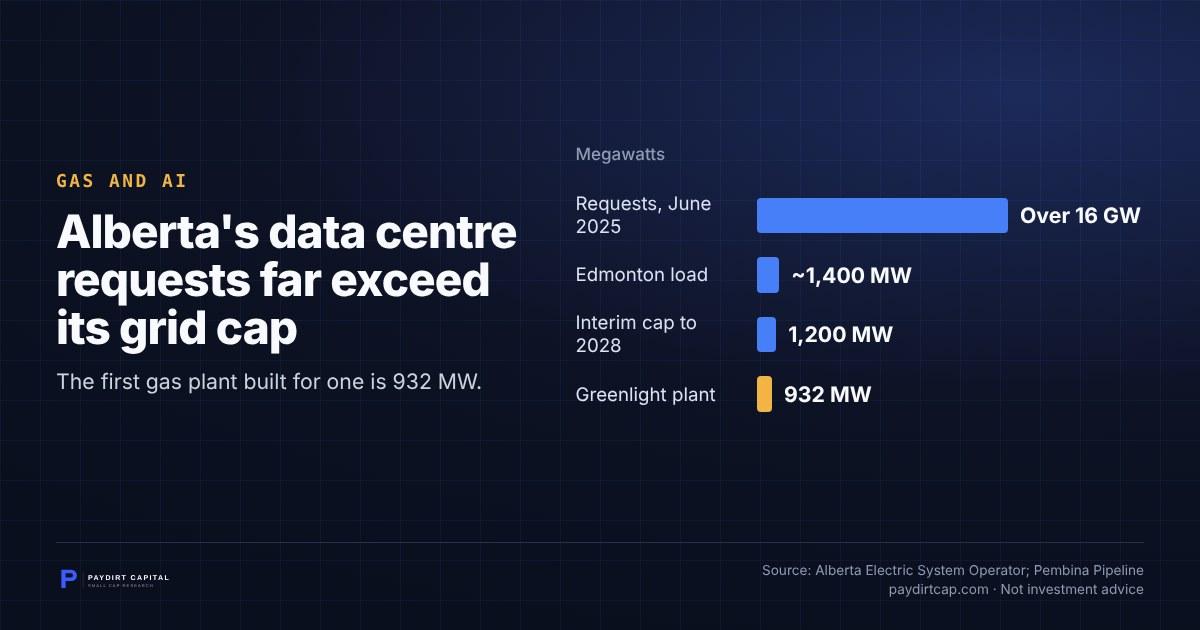
- Alberta capped large-load grid connections at 1,200 MW through 2028 after requests topped 16 GW, then passed rules favouring self-supplied power.
- The 932 MW Greenlight gas plant for Meta's Sturgeon County data centre would use about 0.8% of Canada's 2025 gas output.
AI data centres need large amounts of electricity around the clock, and natural gas is one of the few sources that can be built at gigawatt scale and dispatched on demand. In the United States gas already supplies the largest share of power, and in Canada, Alberta has become the test case for gas plants built specifically to serve data centres. This piece explains how that arrangement works and what the numbers look like.
How much power data centres use
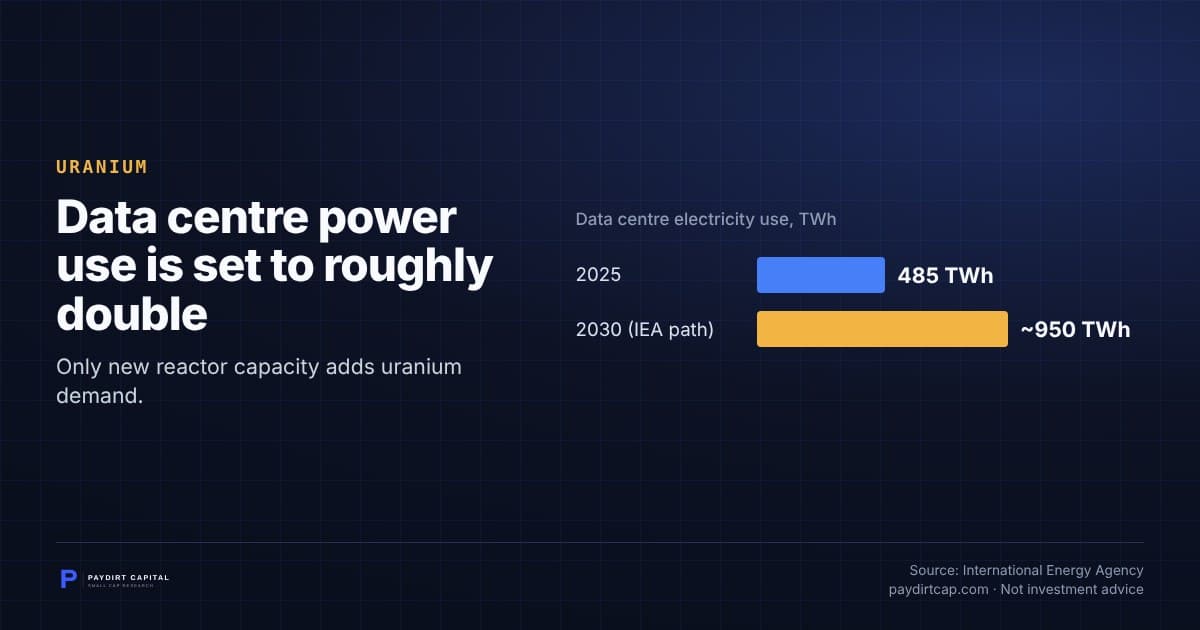
The International Energy Agency (IEA) estimates data centres used about 415 terawatt hours (TWh) of electricity in 2024, roughly 1.5% of global consumption. In its base case, the IEA projects that rising to about 945 TWh by 2030, just under 3% of global demand, growing around 15% a year. The IEA expects US data centre consumption to rise by about 240 TWh, or 130%, over the same period, and says data centres account for nearly half of US electricity demand growth to 2030.
For more on the demand side, see our piece on AI data centres and power demand.
Why gas keeps showing up
A data centre running AI training or inference wants firm power: the same load every hour of every day. That favours sources that can run on demand. The IEA's own projection is that renewables supply the largest share of new data centre demand, growing by over 450 TWh to 2035, with natural gas expanding by 175 TWh to meet data centre demand, notably in the United States. The IEA expects nuclear to contribute about the same additional amount as gas.
The US grid already leans on gas. According to the US Energy Information Administration (EIA), natural gas supplied about 41% of US utility-scale electricity generation in 2025, followed by renewables at about 24%, nuclear at about 18% and coal at about 17%.
Two supply models have emerged:
- Utility-built plants. A regulated utility builds gas generation and recovers the cost through rates or a contract with the data centre. On August 20, 2025, Louisiana regulators approved Entergy Louisiana's plan to build three combined cycle gas plants tied to Meta's data centre in Richland Parish, two there and one at its Waterford site in St. Charles Parish.
- Behind-the-meter plants. A dedicated plant sits next to the data centre and supplies it directly under a long-term contract, reducing the load placed on the public grid.
The Canadian case: Alberta
Alberta has large natural gas supply and drew a wave of data centre proposals. It also ran into a grid limit quickly. On June 4, 2025, the Alberta Electric System Operator (AESO) said 29 proposed large-load projects had asked for more than 16 gigawatts (GW) of capacity, and set an interim limit of 1,200 megawatts (MW) for large loads through 2028. For scale, the AESO noted Edmonton's load is about 1,400 MW.
The province then changed the rules. The Utilities Statutes Amendment Act, 2025 (Bill 8) received royal assent on December 11, 2025. According to the Government of Alberta, it encourages data centres to bring their own generation and requires them to pay for any transmission upgrades they need rather than passing those costs to Alberta ratepayers.
The first large project under that model followed in July 2026:
| Date | Event |
|---|---|
| July 2, 2026 | Pembina Pipeline announced a positive final investment decision on the Greenlight Electricity Centre: a 932 MW combined cycle gas plant in Sturgeon County, dedicated to a major data centre under a long-term tolling agreement. |
| July 2, 2026 | Greenlight's capital cost estimate: about $4 billion gross, about $2 billion net to Pembina. Ownership: Pembina 47.5%, Morgan Stanley Infrastructure Partners 47.5%, Kineticor 5%. Expected in service in the second half of 2030. |
| July 8, 2026 | Meta announced a C$13 billion, 1 GW data centre in Sturgeon County, its first in Canada, supplied by the Greenlight plant. Meta said it will fully fund new generation and grid infrastructure for the site. |
Pembina says Greenlight will use two Siemens Energy gas turbines and two steam turbines, and consume about 150 million cubic feet of natural gas per day.
The math: what one plant means for gas demand
Take Pembina's figures and run them through.
- Electricity. 932 MW running for 24 hours produces 22,368 megawatt hours (MWh) per day. Over a full year that is about 8.2 TWh, if the plant ran flat out every hour, which real plants do not.
- Gas energy. The EIA puts the average heat content of US natural gas delivered to end users at about 1,037 Btu per cubic foot in 2025. At that value, 150 million cubic feet per day is about 155.6 billion Btu per day.
- Efficiency check. 155.6 billion Btu divided by 22.4 million kilowatt hours is roughly 6,950 Btu per kWh. That is the implied heat rate, consistent with a modern combined cycle plant. Alberta gas has its own heat content, so treat this as an order-of-magnitude check.
- Share of Canadian supply. The Canada Energy Regulator reports Canadian natural gas production averaged about 19.0 billion cubic feet per day in 2025, a record. Greenlight's 0.15 billion cubic feet per day would be about 0.8% of that.
- Share of global data centre power. 8.2 TWh is about 2% of the IEA's 415 TWh estimate for global data centre use in 2024.
One campus, then, is small against national gas output but large against a single provincial grid. That gap is why the policy fight in Alberta has been about grid access and cost allocation, not gas supply alone.
Trade-offs to understand
- Emissions. A gas plant emits carbon dioxide for its full life. How that is treated depends on federal and provincial carbon rules, which can change.
- Timing. Greenlight's expected in-service date is the second half of 2030, four years after the investment decision. Power plants, turbines and pipelines take years to deliver.
- Concentration. A behind-the-meter plant tied to one customer depends on that customer's contract. Pembina describes it as a long-term tolling agreement; the full terms are not public.
- Local approval. Projects still need municipal and Alberta Utilities Commission approvals.
Our explainer on Canada's AI compute push covers the federal side.
What to watch
- AESO announcements on large-load connections and any change to the 1,200 MW interim limit.
- Alberta Utilities Commission decisions on data centre power plant applications.
- Canada Energy Regulator monthly production data and market snapshots.
- Pembina quarterly filings for Greenlight construction updates.
- EIA monthly electricity data on the US generation mix, and IEA updates to its Energy and AI analysis.
Sources
- IEA, Energy and AI: Energy demand from AI
- IEA, Energy and AI: Executive summary
- EIA, Electricity in the U.S.
- EIA, Natural gas conversion FAQ (heat content)
- AESO, Interim approach to large load connections (June 4, 2025)
- Government of Alberta, Powering new pathways for data centres
- Pembina Pipeline, Final investment decision on the Greenlight Electricity Centre (July 2, 2026)
- Canada Energy Regulator, Canada's natural gas production kept climbing in 2025
Frequently asked questions
Why do AI data centres use natural gas power?
AI data centres need firm electricity every hour of the day, and gas plants can be built at large scale and run on demand. The IEA projects renewables will supply the largest share of new data centre demand to 2035, with natural gas adding 175 TWh, mostly in the United States, where gas supplied about 41% of utility-scale generation in 2025.
How much gas does the Greenlight plant for Meta use?
Pembina says the 932 MW Greenlight Electricity Centre in Sturgeon County, Alberta, will consume about 150 million cubic feet of natural gas per day. The Canada Energy Regulator reports Canadian production averaged about 19.0 billion cubic feet per day in 2025, so the plant would use roughly 0.8% of national output. It is expected in service in the second half of 2030.
What is Alberta's bring your own power rule for data centres?
Alberta's Utilities Statutes Amendment Act, 2025, which received royal assent on December 11, 2025, encourages data centres to bring their own generation and requires them to pay for transmission upgrades they need. It followed the AESO's June 2025 decision to cap large-load connections at 1,200 MW through 2028 after requests exceeded 16 GW.
Related reading
Disclaimer
This content is published by Paydirt Capital, a brand of Apollo Shareholder Relations, for informational purposes only. It is not investment advice, a recommendation, or an offer or solicitation to buy or sell any security. Nothing here should be relied on for investment decisions. Readers should conduct their own due diligence and consult a registered investment advisor before making any investment.
Apollo Shareholder Relations provides paid investor relations, marketing, and communications services to publicly traded companies and may be compensated in cash or securities by companies in the sectors discussed. Where a company mentioned in this content is or becomes a client, Apollo may hold a financial interest in that company and its securities. This content is not independent research.
All facts and figures are drawn from public sources believed to be reliable, but accuracy is not guaranteed. Any forward-looking statements reflect current expectations only and actual outcomes may differ materially. Paydirt Capital and Apollo Shareholder Relations accept no liability for any loss arising from the use of this content.
The Weekly Dig
Find more good dirt in your inbox. The latest stories and ideas, free to subscribe.
Free to subscribe. Unsubscribe anytime. Sponsored content is disclosed.