Before Nevada’s Silver Rush, There Was Silver Hill
The fascinating history of America's first silver mine, the challenges that brought early operations to a halt, and why modern exploration is taking another look.
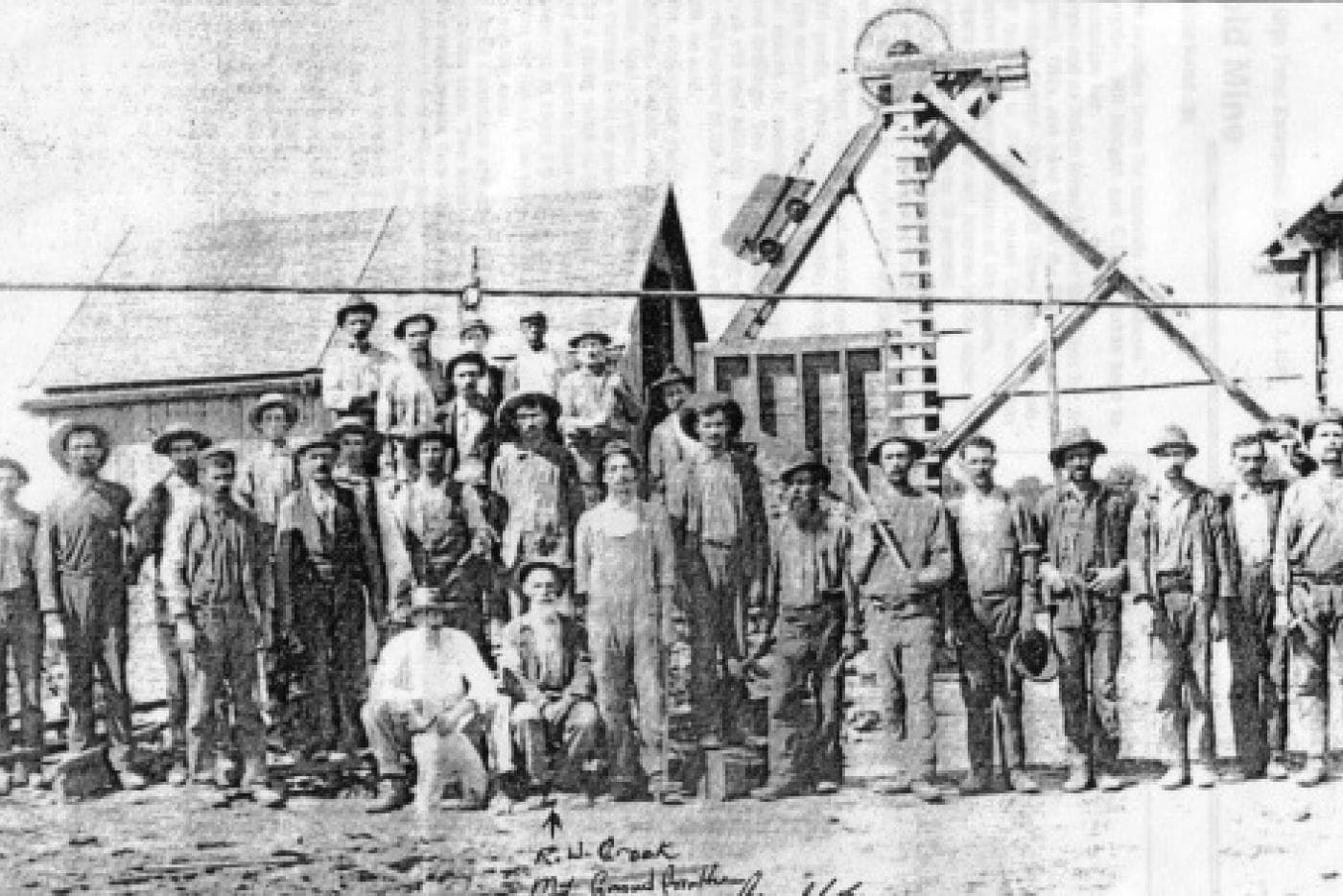
Cover photograph: Miners at Silver Hill, circa 1900. Credit: Davidson County Historical Society, via the North Carolina Department of Natural and Cultural Resources.
When most people think about the history of silver mining in America, their minds probably turn to the Wild West. Nevada's famous Comstock Lode, dusty mining towns, fortunes made almost overnight, and prospectors chasing the next great discovery.
It's an understandable association. The discovery of the Comstock Lode in 1859 helped transform Nevada into one of the world's most important silver-producing regions, eventually yielding hundreds of millions of dollars in precious metals and contributing to the development of the American West.
But America's silver mining story actually began much farther east.
Twenty years before the Comstock discovery, miners were already extracting silver from the rolling hills of North Carolina. Their operation would become known as Silver Hill, recognized as the first silver mine in the United States.
Its history is remarkable for more than its age. It is a story of early discoveries, ambitious engineering, difficult working conditions, and a geological challenge that nineteenth-century technology struggled to overcome.
Nearly two centuries later, that same geology is attracting renewed attention.
America's First Silver Mine Was Born During a Gold Rush
Silver mining was hardly new to the Americas in the nineteenth century. Spanish colonial operations had been extracting enormous quantities of the metal from regions such as Mexico since the 1500s. The famous silver deposits around Zacatecas, discovered in 1546, helped establish an industry that would influence global trade for centuries.
Mining in the territory that became the United States followed a different path.
In 1799, a large gold nugget was discovered on the Reed family farm in North Carolina. That discovery helped ignite America's first gold rush, decades before California became synonymous with prospecting.
By the 1820s and 1830s, prospectors were searching streams, hillsides, and exposed rock formations throughout the North Carolina Piedmont. Gold was the primary attraction, but the region held more than one valuable metal.
In 1838, a mineral discovery on a hilltop near Lexington, in Davidson County, would lead to something unexpected.
The property was purchased by Roswell A. King, who began developing the deposit. King and John W. Thomas subsequently received a charter from the North Carolina General Assembly, establishing the Washington Mining Company in 1839.
On January 7 of that year, the operation opened as America's first silver mine.
The discovery was particularly interesting because the upper portions of the deposit contained native silver, meaning silver occurring naturally in metallic form, alongside lead-bearing minerals.
But what made Silver Hill valuable also made it complicated. The deposit contained several different metals distributed through interconnected mineralized veins. Understanding and recovering those metals would eventually become one of the defining challenges of the operation.
Mining Silver Before Electricity, Modern Machinery, or Geological Models
To appreciate what made Silver Hill extraordinary, it helps to understand what mining actually looked like in the 1840s.
There were no computerized geological models showing the likely direction of underground mineralization. No modern diamond drills capable of extracting continuous samples from hundreds of metres below the surface.
Exploration largely depended on what miners could observe, excavate, and follow underground.
At Silver Hill, the original operators identified two principal mineralized veins, known as the East and West Lodes. By the mid-1840s, the mine had three shafts providing access to underground workings.
The first, known as the Ladder Shaft, reached approximately 60 feet underground. A hand-operated windlass, essentially a rotating drum used to wind rope, helped raise material from below.
Another shaft extended nearly 170 feet underground, with horses powering equipment used to lift both ore and water.
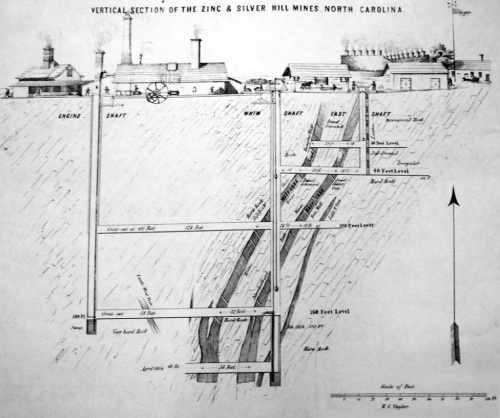
Water was a constant problem. As mines grew deeper, keeping underground workings dry required increasingly sophisticated pumping systems. By 1845, Silver Hill's operators were pursuing steam-powered machinery to improve their operation.
Once the rock reached the surface, extracting valuable minerals required an entirely different set of processes.
Historical accounts describe ore being broken apart with hammers before passing through washing troughs and devices called jigs. These used water and repeated movement to separate heavier, mineral-rich particles from lighter waste material.
The concentrated material then underwent heating and smelting, where furnaces helped separate metals from the surrounding minerals.
It was physically demanding work, carried out around heavy machinery, deep shafts, water-filled workings, and extremely hot furnaces. Skilled miners, including workers with experience in British mining districts, contributed to the industry's development.
And even after all that effort, the metal still had a long journey ahead.
Lead ingots produced at Silver Hill, often weighing between 75 and 80 pounds each, were hauled approximately 100 miles by wagon to Fayetteville, North Carolina.
From there, they travelled down the Cape Fear River to Wilmington before continuing by schooner to Philadelphia, where further refining took place.
Consider the logistics. Rock extracted underground by manual labour and early machinery was processed, cast into heavy ingots, transported across North Carolina, loaded onto vessels, and shipped hundreds of miles before its precious-metal content could be fully recovered.
Yet Silver Hill was producing valuable material. Records from the 1840s document shipments containing silver and gold that were processed through the United States Mint.
The difficulty wasn't necessarily finding the metals.
It was figuring out how to recover them efficiently.
The Deeper They Dug, the More Complicated the Ore Became
One of the most fascinating aspects of Silver Hill's history is that its original operators didn't simply run out of mineralization.
They encountered a problem with the minerals themselves.
Near the surface, the deposit contained native silver and oxidized lead minerals, including cerussite. As mining progressed deeper underground, the composition changed.
The miners increasingly encountered galena, a mineral containing lead and sulphur, and sphalerite, which contains zinc and sulphur.
Silver, lead, zinc, and smaller quantities of other metals were present together in increasingly complex combinations.
To someone unfamiliar with mining, that might sound like a good problem to have. More metals should mean more potential value.
But recovering them is another matter.
A valuable deposit is not necessarily one that can be mined profitably. The minerals must also be separated and processed without spending more money than the recovered metals are worth.
At Silver Hill, zinc-bearing minerals complicated the smelting process. Significant quantities of valuable lead and silver were being lost during refining.
The operators experimented with different furnace designs, including English and German technologies, trying to find a more effective method.
These experiments were expensive, technically challenging, and ultimately unable to resolve the losses.
In 1852, after years of struggling with its metallurgy, the original mining operation closed.
That distinction matters.
Silver Hill's early closure was not simply proof that its mineralization had been exhausted. The operators struggled to process increasingly complex material with the methods available to them.
It is a problem that has appeared repeatedly throughout mining history.
A deposit can contain valuable metals but remain uneconomic because the equipment, processing technology, transportation infrastructure, or prevailing metal prices do not support profitable production.
What qualifies as an economically recoverable deposit can change considerably from one generation to the next.
A Mine That Refused to Disappear
Silver Hill's first closure wasn't the end of its story.
In 1854, new ownership reopened the property under the Silver Hill name. During the American Civil War, the operation became a source of lead for the Confederacy.
An unusual piece of mining folklore emerged during this period. Because silver was not separated from the lead used for wartime ammunition, stories circulated about soldiers firing silver bullets.
Whether or not those stories captured the reality, they illustrate the unusual mixture of metals that made Silver Hill difficult to process.
Mining continued intermittently after the war, but metallurgical challenges, financial difficulties, and ownership disputes persisted. Major operations eventually ceased in 1882.
Interest in the property, however, continued well into the twentieth century.
The United States Bureau of Mines examined Silver Hill during the Second World War, when securing domestic supplies of strategically important metals had become a national priority.
Further exploration followed in the late 1950s and around 1960. Work by Tennessee Copper Company encountered additional lead and zinc mineralization at depth, but the discoveries were not considered sufficient to justify reopening the mine economically.
That is an important part of the history too. Silver Hill has attracted multiple generations of exploration, and renewed interest has not always translated into a successful mining operation.
Still, the successive investigations accumulated something valuable: geological information.
Old mine plans, underground observations, drill records, and technical reports created a historical record that future explorers could revisit.
And the tools available to interpret that record would improve dramatically.
What Modern Technology Can See That Early Miners Couldn't
Imagine trying to understand the layout of a large building by exploring it one room at a time, without architectural drawings or the ability to see through its walls.
That is somewhat similar to the challenge facing early underground miners.
They could follow mineralized rock through tunnels and shafts, but determining what lay beyond those workings was expensive and uncertain.
Today, exploration companies have a much broader set of tools.
Historical maps and drill records can be incorporated into three-dimensional computer models, allowing geologists to visualize the orientation of mineralized zones and identify gaps in previous exploration.
Modern diamond drills extract cylindrical samples of rock called cores from hundreds of metres underground. These samples reveal the sequence of rock formations, mineral structures, and metal concentrations along the drill hole.
Geophysical surveys add another dimension.
One particularly useful technique is induced polarization, commonly called IP. It measures how underground materials respond to an electrical current, helping geologists identify areas that may contain concentrations of certain minerals.
Sulphide minerals, including some of those associated with silver, lead, and zinc deposits, can generate recognizable responses.
Think of it as an additional way of investigating what might lie underground without first digging a mine.
An IP anomaly does not prove the presence of valuable metal, and drilling is still required to determine what is actually there. But when combined with geological mapping and historical records, it can help explorers prioritize where to investigate.
That ability to connect different types of information is particularly relevant at historic mining properties.
The original miners often focused on the mineralization they could physically reach. Modern exploration can investigate whether those same geological structures extend beyond the boundaries of the original workings.
For a property like Silver Hill, that opens the door to questions its nineteenth-century operators could never fully answer.
Nearly Two Centuries Later, Just How Big Could Silver Hill Be?
When Silver Hill's original operators were struggling with their furnaces and underground workings, they had little way of knowing whether the mineralized veins they were following represented most of the deposit or only a small part of something much larger.
That uncertainty is what makes the property's modern exploration story particularly interesting.
Today, Canadian-listed Metalsource Mining Corp. (CSE: MSM | OTCQB: MSMMF | FSE: E9Z) is revisiting the historic mine with a different objective. Rather than simply reopening the old workings, the company is trying to establish how far the silver, gold, lead, and zinc mineralization actually extends.
Its approximately 1,300-acre Silver Hill land position encompasses the historic mine and surrounding exploration ground.
And instead of relying exclusively on the mineralized veins identified by nineteenth-century miners, Metalsource is combining historic records, modern geophysics, geological modelling, and diamond drilling to investigate the broader system.
In 2023, SRK Consulting incorporated historical exploration information, including drilling from the 1960s, into a three-dimensional geological model of the property. That provided a foundation for examining where previously identified mineralization might continue beyond the areas earlier operators were able to explore.
The company's 2026 drilling results have begun adding some interesting pieces to that picture.
In June, drill hole SH26-18 extended mineralization approximately 28 metres south of an earlier hole, returning 11.8 metres grading 245 grams per tonne silver equivalent, including a narrower interval grading 1,580 grams per tonne.
Another hole, SH26-19, stepped approximately 33 metres farther down the interpreted plunge of the mineralized corridor and returned 6.28 metres grading 1,156 grams per tonne silver equivalent.
Plunge describes the direction a geological feature extends downward through the ground. Following that direction helps geologists investigate whether a mineralized zone continues deeper beneath the surface.
Subsequent drilling reported in August tested extensions as deep as approximately 335 metres below surface. The results included 15.3 metres grading 207 grams per tonne silver equivalent in SH26-21, as the company continued investigating the system at depth.
For readers unfamiliar with drilling results, silver equivalent, abbreviated AgEq, expresses the calculated combined value of multiple metals as an equivalent amount of silver. It does not mean every gram represents actual silver, and the economic recoverability of those metals still requires evaluation. Reported intercept lengths are measured along drill cores, not necessarily the true thickness of the mineralized zones.
But beyond the individual grades, something else is taking shape.
Metalsource is continuing to encounter mineralization as it drills away from previously established areas.
That matters because determining the size of a mineralized system requires more than identifying one particularly rich section of rock. Geologists need to understand whether that mineralization continues over meaningful distances, how its thickness and grade change, and whether apparently separate intersections belong to a larger geological structure.
This is the purpose of step-out drilling.
Rather than drilling repeatedly within an already understood area, a company places new holes farther away to investigate the edges of known mineralization. Each successful intersection potentially moves those boundaries outward.
At Silver Hill, those exploration steps are becoming progressively more ambitious.
On October 22, MetalSource reported that a new southern step-out hole, SH26-45, had visually intersected approximately 22 metres of polymetallic mineralization, including semi-massive sulphides and mineralized veins.
The hole was positioned approximately 80 metres south of SH26-27, extending the investigation farther beyond the previously drilled area.
Laboratory assays were still pending at the time of the announcement, so the metal grades of that intersection remained unknown. Nevertheless, observing mineralization with characteristics similar to earlier intersections at a greater distance provides additional geological information about how the system may continue.
The company is also looking well beyond its current drilling footprint.
Geophysical surveys have identified priority targets approximately 1.1 kilometres north of Silver Hill, while surface sampling has identified additional mineralization approximately 240 metres northeast of the historic mine.
These areas have not yet been demonstrated to contain continuous economic mineralization. Geophysical anomalies are exploration targets, not discoveries in themselves.
But the distances illustrate how much broader the current investigation has become.
Nearly two centuries ago, the original miners were trying to establish whether their veins continued beyond the tunnels they had excavated.
Today, Metalsource is following a similar geological question across a considerably larger area, using two drill rigs and modern exploration techniques.
Its drilling has confirmed mineralization in multiple locations and at considerable depths, while leaving the northern, southern, and deeper limits of the system open for exploration and potential expansion.
The company has not yet established a current mineral resource estimate or demonstrated that Silver Hill could support an economically viable modern mine. Further drilling, geological modelling, metallurgical testing, and economic analysis remain necessary.
Yet that is precisely why the next phase of exploration is worth following.
The historical mine tells us where miners first discovered valuable metals. The modern drilling is beginning to show that mineralization extends beyond some of those original boundaries.
What remains unanswered is just how far it goes.
Could the historic Silver Hill workings represent only a portion of a much larger mineralized system? Or will further drilling eventually define its limits?
That is the question MetalSource is now working to answer, one drill hole at a time.
The Past May Hold Clues to the Future
Mining history is full of discoveries that were important in their time but limited by the technologies available to develop them.
Some deposits were worked until their accessible mineralization was exhausted. Others became too expensive to operate, too technically difficult to process, or simply fell out of favour as economic conditions changed.
Distinguishing between those circumstances is one reason historical mining districts continue to attract exploration interest.
Silver Hill offers an unusually clear example.
Its earliest miners worked with hand-operated equipment, horse-powered machinery, and experimental furnaces. They discovered silver, lead, and other valuable metals, but struggled to determine how far the deposits extended and how to recover them economically.
Even in 1845, engineers were asking whether the veins continued farther north and south.
It is remarkable that nearly 200 years later, those same directions remain central to the exploration story.
The difference today is that modern drilling and geological technology are beginning to provide information the original operators could never have obtained.
The results so far have given Metalsource reasons to keep expanding its exploration. Graded mineralized intersections have been encountered beyond earlier drilling, additional mineralization has been visually identified farther south, and larger targets remain to be tested.
This raises a fascinating possibility.
What if the nineteenth-century miners understood the richness of what they had discovered, but never had the means to understand its true extent?
Nearly two centuries after America's first silver mine opened beneath the hills of North Carolina, that question is finally being investigated with modern tools.
The geology hasn't changed. What has changed is our ability to discover just how much of it is there.
And at Silver Hill, the next drill results could bring that answer a little closer.
Follow Metalsource Mining's exploration of Silver Hill: www.metalsourcemining.com
Sources and further reading
- North Carolina Department of Natural and Cultural Resources: Nineteenth Century Silver Mining in Davidson County - Historical discovery, opening, ownership and mining chronology.
- Mining History Association: The Silver Hill Mine, by L. Michael Kaas, 2009 - Detailed historical research covering mining methods, transport, metallurgy, production and later exploration.
- U.S. Geological Survey: The Comstock Lode Precious-Metal District - Nevada's silver mining history and mineral production.
- U.S. Geological Survey: Induced Polarization - Explanation of geophysical technology used in mineral exploration.
- MetalSource Mining: Silver Hill Project - Property information, historical work, modelling and exploration results.
- MetalSource Mining: October 7, 2026 Exploration Update - Expanded drilling and geophysical targets.
- MetalSource Mining: October 22, 2026 Exploration Update - Southern step-out drilling and pending assays.
Disclaimer
This content is published by Paydirt Capital, a brand of Apollo Shareholder Relations, for informational purposes only. It is not investment advice, a recommendation, or an offer or solicitation to buy or sell any security. Nothing here should be relied on for investment decisions. Readers should conduct their own due diligence and consult a registered investment advisor before making any investment.
Apollo Shareholder Relations provides paid investor relations, marketing, and communications services to publicly traded companies and may be compensated in cash or securities by companies in the sectors discussed. Where a company mentioned in this content is or becomes a client, Apollo may hold a financial interest in that company and its securities. This content is not independent research.
All facts and figures are drawn from public sources believed to be reliable, but accuracy is not guaranteed. Any forward-looking statements reflect current expectations only and actual outcomes may differ materially. Paydirt Capital and Apollo Shareholder Relations accept no liability for any loss arising from the use of this content.