Escrow and Hold Periods on New Shares in Canada Explained
The four-month hold under NI 45-102, the TSX Venture hold, NP 46-201 escrow schedules and TSXV Policy 5.4: when newly issued shares in Canada can trade.
Key takeaways
- Shares bought in most Canadian private placements carry a legend barring trades until four months and a day after the distribution date.
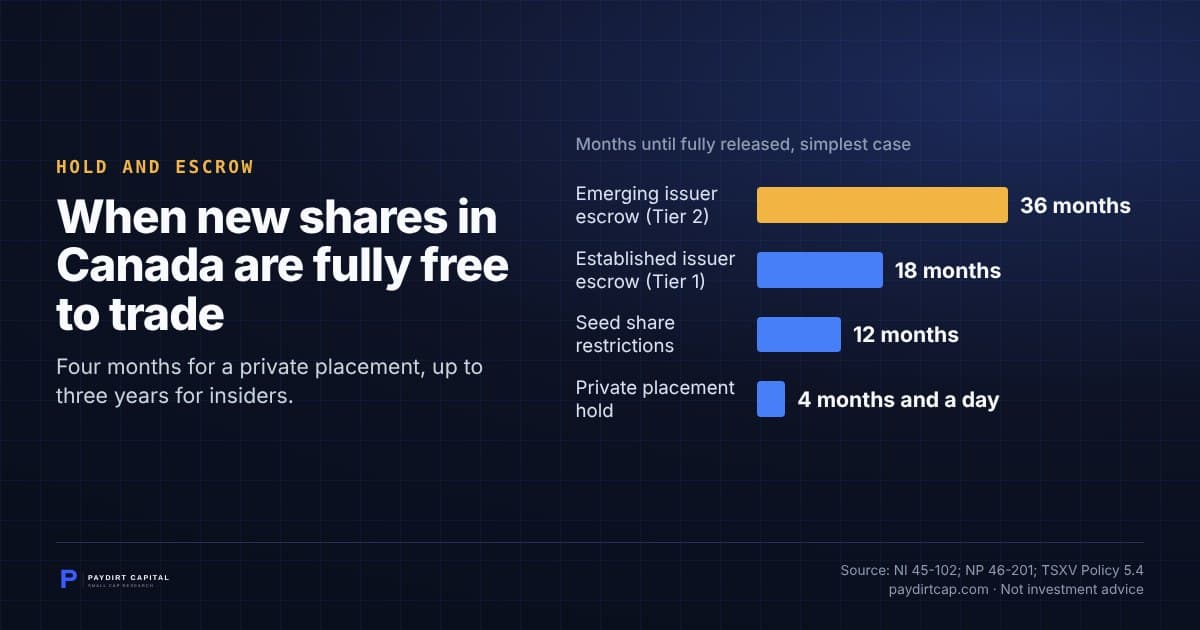
- Under NP 46-201, emerging issuers release 10% of escrowed shares at listing and 15% every six months over 36 months.
- Shares issued under the listed issuer financing exemption are freely tradeable, with no four-month hold.
Newly issued shares in Canada often cannot be sold right away. Two separate systems cause this: statutory hold periods, which mostly last four months, and escrow, which can lock up insiders' shares for as long as three years after a listing. They apply to different people for different reasons, and both are set out in public rules.
Hold periods and escrow are different tools
- A hold period is a resale restriction on securities bought under a prospectus exemption, such as a private placement. It applies to any buyer, insider or not, and expires on a set date.
- Escrow applies to principals, meaning founders, directors, senior officers and large holders, when a company goes public or completes a transaction such as a reverse takeover. Shares are held by an escrow agent and released in stages.
The four-month hold
National Instrument 45-102 governs resale of securities bought under most prospectus exemptions. Under section 2.5, a holder can resell without a prospectus if several conditions are met, including:
- The issuer is and has been a reporting issuer in a Canadian jurisdiction for the four months before the trade.
- At least four months have passed since the distribution date.
- The certificate or electronic position carries a legend stating the holder must not trade before the date that is four months and a day after the distribution date.
- The trade is not a control distribution, no unusual effort is made to prepare the market, and no extraordinary commission is paid.
TSX Venture adds its own Exchange Hold Period, also four months. It applies to securities issued to directors, officers, promoters, consultants and certain 10% holders even where securities law imposes no hold, with exceptions for prospectus offerings, take-over bids, rights offerings and similar statutory procedures. It also applies to stock options granted below the Market Price and to securities issued at less than $0.05.
One exemption produces free-trading shares. The listed issuer financing exemption took effect November 21, 2022, and the BC Securities Commission notes that securities issued under it are freely tradeable. Under coordinated blanket orders published May 14, 2025, an issuer can raise the greater of $25 million and 20% of the market value of its listed securities, up to $50 million, in a 12-month period.
Escrow on an IPO: National Policy 46-201
National Policy 46-201 sets escrow for initial public offerings. It applies to principals: promoters within two years before the prospectus, directors and senior officers, anyone holding more than 20% of votes, and anyone holding more than 10% who can elect or appoint a director or senior officer. A principal with less than 1% of votes after the IPO is not subject to escrow.
The definition reaches past individuals. A company, trust or partnership more than 50% held by principals is treated as a principal. So are a principal's spouse and relatives who live at the same address. Convertible securities such as options and warrants count when the percentages are calculated.
The schedule depends on how the issuer is classified after its IPO:
| Classification | Who it covers | Release schedule (simplest case) |
|---|---|---|
| Exempt issuer | TSX issuers classified as exempt, or issuers with a market capitalization of at least $100 million at the IPO price | Escrow not generally required |
| Established issuer | Non-exempt TSX issuers and TSX Venture Tier 1 issuers | 25% at listing, then 25% every six months; fully released after 18 months |
| Emerging issuer | All others, including TSX Venture Tier 2 | 10% at listing, then 15% every six months; fully released after 36 months |
Escrow on other transactions: TSX Venture Policy 5.4
Many venture companies go public through a reverse takeover or a capital pool company's qualifying transaction rather than an IPO. TSX Venture's Policy 5.4, rewritten effective June 2, 2025, covers those. For IPOs it defers to NP 46-201, treating Tier 1 issuers as established and Tier 2 issuers as emerging. For other transactions it imposes substantially the same escrow on principals' securities, with notable differences. Escrow still applies where the issuer will have a market capitalization of at least $100 million, though the issuer may ask for an exemption.
According to a Fasken summary of the change, the rewrite removed the older "surplus securities" escrow category and moved all principals onto the value-security schedule that matches NP 46-201. Non-principals holding seed shares face Seed Share Resale Restrictions: a one-year period with 20% released every three months, the first release on the exchange bulletin date.
The math: three release calendars
Illustrative figures for a principal with 10,000,000 escrowed shares, and a private placement closing on a set date:
- Tier 2 (emerging) escrow: 1,000,000 at listing, then 1,500,000 at 6, 12, 18, 24, 30 and 36 months. Six releases of 1,500,000 total 9,000,000, plus the first 1,000,000.
- Tier 1 (established) escrow: 2,500,000 at listing and at 6, 12 and 18 months.
- Seed Share Resale Restrictions (10,000,000 seed shares): 2,000,000 on the bulletin date and at 3, 6, 9 and 12 months.
- Four-month hold: units from a private placement that closes on October 15, 2026 carry a legend date of February 16, 2027, which is four months and a day later.
Each release adds shares that holders are free to sell. That does not mean they will sell. It does mean the tradable supply changes on dates that can be known in advance. The same idea drives calendar effects discussed in our piece on tax-loss selling on the TSX Venture and CSE.
What to watch
- The escrow section of a prospectus, filing statement or listing statement, which lists escrowed holders, share counts and release dates.
- Hold expiry dates stated in private placement closing news releases.
- TSX Venture bulletins confirming final acceptance of a transaction, which set the bulletin date that starts the release clock.
- Insider trading reports on SEDI after release dates.
Sources
- National Instrument 45-102 Resale of Securities (BC Laws)
- National Policy 46-201 Escrow for Initial Public Offerings (OSC consolidation)
- TSX Venture Exchange Corporate Finance Manual (Policies 1.1, 5.4)
- Fasken: From Escrow to Exit, New TSXV Policy 5.4
- BCSC: Listed Issuer Financing Exemption
Frequently asked questions
What is the four month hold period in Canada?
Under National Instrument 45-102, securities bought under most prospectus exemptions, such as private placements, cannot be resold until at least four months have passed since the distribution date. The certificate or electronic position carries a legend stating the holder must not trade before the date four months and a day after distribution.
How does NP 46-201 escrow work?
National Policy 46-201 requires principals of an issuer going public to place their shares in escrow. Established issuers, including TSX Venture Tier 1, release 25% at listing and 25% every six months over 18 months. Emerging issuers release 10% at listing and 15% every six months over 36 months.
Are LIFE offering shares subject to a hold period?
No. The BC Securities Commission notes that securities issued under the listed issuer financing exemption are freely tradeable. The exemption took effect November 21, 2022. Under blanket orders published May 14, 2025, issuers can raise the greater of $25 million and 20% of market value, up to $50 million, in 12 months.
Related reading
Disclaimer
This content is published by Paydirt Capital, a brand of Apollo Shareholder Relations, for informational purposes only. It is not investment advice, a recommendation, or an offer or solicitation to buy or sell any security. Nothing here should be relied on for investment decisions. Readers should conduct their own due diligence and consult a registered investment advisor before making any investment.
Apollo Shareholder Relations provides paid investor relations, marketing, and communications services to publicly traded companies and may be compensated in cash or securities by companies in the sectors discussed. Where a company mentioned in this content is or becomes a client, Apollo may hold a financial interest in that company and its securities. This content is not independent research.
All facts and figures are drawn from public sources believed to be reliable, but accuracy is not guaranteed. Any forward-looking statements reflect current expectations only and actual outcomes may differ materially. Paydirt Capital and Apollo Shareholder Relations accept no liability for any loss arising from the use of this content.