Why Some of the World’s Richest Gold Discoveries Share the Same Geological DNA
From ancient underground hot-water systems to multimillion-ounce gold deposits, understanding how nature concentrates gold may be just as important as knowing where to look.
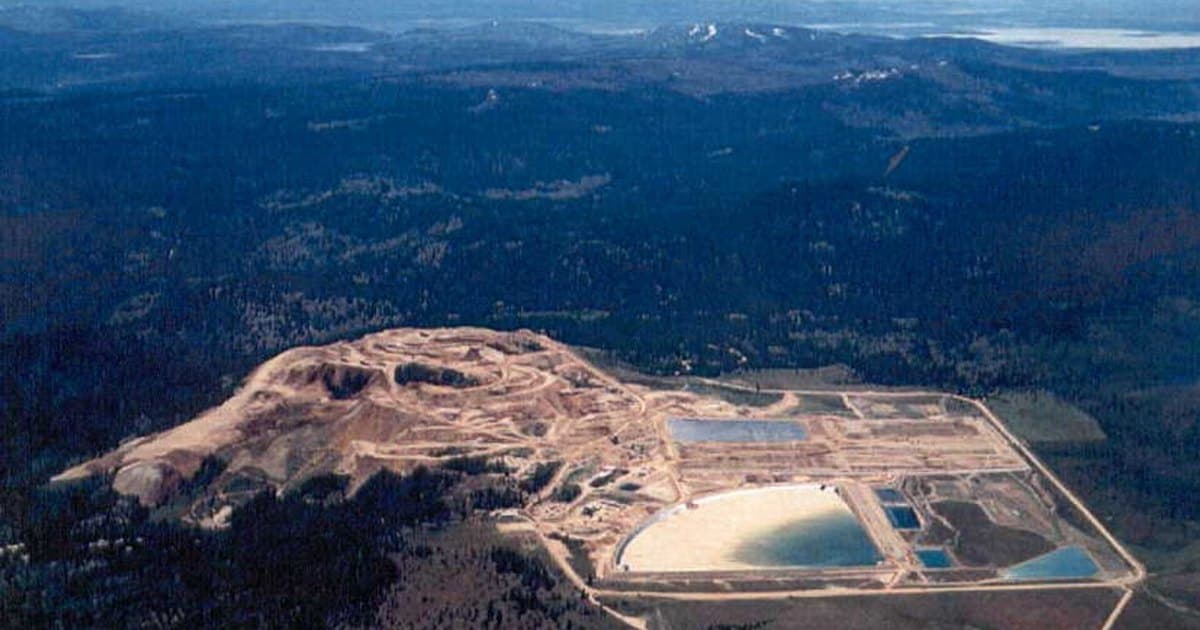
Cover photograph: Hayden Hill, Lassen County, California. Credit: Four Nines Gold Inc.
In 1870, a group of travellers passing through the hills of northern California reportedly made an unusual discovery. Near a natural spring on the southern side of a hill, they found gold.
The discovery would eventually give rise to Hayden Hill, a mining district that experienced several periods of activity before becoming a modern open-pit gold operation in the 1990s. By the time mining ended, approximately 480,000 ounces of gold and 1.3 million ounces of silver had been recovered.
But there's something particularly interesting about how that gold got there in the first place.
Long before anyone began prospecting in California, natural geological processes were transporting and concentrating gold beneath the Earth's surface. And one of the most important ingredients in those processes was something remarkably ordinary.
Water.
Not the cool spring water encountered by those early prospectors, but hot, chemically active fluids circulating through ancient volcanic rocks.
These underground systems are responsible for some of the world's most remarkable gold deposits. At Nevada's Midas Mine, for example, a network of mineralized veins has historically produced approximately 2.2 million ounces of gold and 27 million ounces of silver. Thousands of kilometres away, Ecuador's Fruta del Norte district contains millions of ounces of gold in exceptionally rich mineral deposits.
Despite their different locations and geological characteristics, these deposits share an important connection. They belong to a family of mineral deposits known as epithermal systems, formed when heated fluids move through underground structures and concentrate precious metals.
Understanding how these systems work has become an important part of modern gold exploration.
And at Hayden Hill, where Four Nines Gold Inc. (CSE: FNAU | OTCQB: FNAUF | FSE: F8NA) is now conducting its first modern drilling campaign, the same geological principles are being used to investigate whether the historic mining operation captured the full extent of the mineralization beneath the property.
How Hot Water Became One of Nature's Most Effective Gold Transport Systems
Gold is present in tiny quantities throughout much of the Earth's crust. The challenge is finding places where natural processes have concentrated enough of it to make mining economically practical.
Imagine trying to recover a handful of grains of sugar scattered across an entire football field. Individually, those grains would be almost impossible to collect. But if a natural process could gather them into one small area, the task would become considerably easier.
Something similar happens with gold.
Deep underground, water can circulate through rocks that have been heated by volcanic activity or nearby bodies of magma. Under the right conditions, chemical compounds dissolved in that water allow it to transport minute quantities of gold.
The amounts involved can be extraordinarily small. Yet when enormous volumes of fluid circulate through rock over thousands or even millions of years, they can move substantial quantities of metal.
A coffee maker provides a useful comparison.
Hot water passes through ground coffee, dissolving certain compounds and carrying them along. Deep underground, heated fluids can similarly interact with rock, transporting dissolved metals as they move.
Of course, nature's version is considerably more complicated.
The fluids may originate from circulating groundwater, cooling magma, or a combination of sources. Their chemistry changes as they pass through different rock formations, sometimes travelling considerable distances through faults and fractures.
The remarkable part happens when those fluids begin to rise.
As pressure decreases, the hot water may begin to boil. It can also cool, mix with other groundwater, or react chemically with the surrounding rock.
These changes can cause gold and silver to separate from the fluid and accumulate within cracks, cavities, and broken sections of rock.
Over long periods of geological time, repeated pulses of fluid movement can build up mineral deposits.
Geologists call these hydrothermal systems, a term describing the movement of heated water through rock.
When the mineralization forms relatively close to the Earth's surface, generally within about 1,500 metres and at temperatures below approximately 300°C, the deposits are classified as epithermal.
They are particularly interesting because the gold doesn't necessarily accumulate in one large, convenient mass.
Instead, it can be distributed throughout an extensive network of underground structures, with some areas containing remarkably high concentrations while others contain very little.
Understanding why gold accumulated in certain places is one of the central challenges facing exploration geologists.
The Hidden Network Beneath a Gold Discovery
One of the easiest ways to visualize an epithermal system is to hold up your hand.
Imagine that each finger represents a different gold-bearing vein or mineralized corridor.
Some are longer than others. Some contain particularly rich concentrations of gold, while others may contain only modest amounts.
Now look at your palm.
Rather than imagining every finger as a separate deposit, think of the palm as representing the broader network of geological structures that may connect different parts of a mineralizing system.
Your wrist represents deeper pathways through which hot, mineral-rich fluids may have travelled upward.
Real epithermal systems are rarely as orderly as a human hand. They can contain multiple fluid pathways, intersecting faults, separate mineralizing events, and complicated arrangements of veins that don't necessarily connect to one central source.
But the analogy illustrates an important principle.
Discovering one gold-bearing vein doesn't necessarily mean you've discovered the entire system responsible for creating it.
This helps explain why geologists spend so much time studying faults and fractures.
A fault is a break in the Earth's crust where rock has moved. Depending on its characteristics, that break can create a pathway through which fluids circulate.
When different faults intersect, they may create additional openings that allow mineral-bearing fluids to flow, react with surrounding rock, and deposit metals.
Over time, these processes can produce veins containing concentrated gold, broader zones of mineralized rock, and structures known as hydrothermal breccias.
Breccias are formed when rock breaks into fragments that become surrounded or cemented by other material. In hydrothermal systems, pressurized fluids can fracture the rock and deposit minerals within the resulting spaces.
These features provide clues about how the ancient system operated.
A geologist encountering a gold-bearing vein might ask whether it continues deeper underground. But they might also investigate nearby faults, intersecting structures, and other geological features that could have influenced where gold was deposited.
The objective is to understand the larger geological environment, rather than treating every occurrence of gold as an isolated discovery.
And sometimes, that understanding has led to extraordinary results.
What the World's Great Epithermal Deposits Can Teach Us
Consider the Midas district in northern Nevada.
The area's mineralization formed through ancient hydrothermal activity, with gold and silver concentrated within networks of veins associated with geological structures.
Over its modern operating history, Midas produced approximately 2.2 million ounces of gold and 27 million ounces of silver, according to its owner, Hecla Mining.
What's remarkable about deposits like Midas is the concentration of gold within certain veins.
Mining companies typically measure gold grades in grams per tonne, abbreviated g/t. A grade of 1 g/t means that every 1,000 kilograms of rock contains, on average, just one gram of gold.
That's roughly the weight of a paperclip distributed throughout a quantity of rock comparable in weight to a small car.
It might not sound like much. But when millions of tonnes of rock are involved, those small quantities can add up.
Now imagine a deposit containing 10 or 20 grams of gold per tonne, or exceptionally rich veins with even higher grades.
Higher concentrations mean more gold can potentially be recovered from each tonne of material, although mining costs, processing methods, and recoveries ultimately determine profitability.
Epithermal systems are capable of forming these high-grade concentrations, sometimes alongside much larger volumes of lower-grade mineralization.
At Nevada's Sleeper Mine, discovered in the 1980s, miners encountered precisely this combination.
The deposit contained exceptionally rich gold veins surrounded by broader areas of mineralized rock. Between 1986 and 1996, AMAX recovered approximately 1.66 million ounces of gold and 2.3 million ounces of silver from the operation.
Sleeper is interesting for another reason. Long after mining ended, exploration and technical studies continued examining gold-bearing material remaining around the historical pit and surrounding property.
The mine had been successful, but understanding the deposit and evaluating its remaining mineralization did not end when production stopped.
Farther south, in Ecuador, Fruta del Norte offers a particularly impressive example of what an epithermal system can produce when substantial mineralized volumes coincide with high gold grades.
Lundin Gold reported that, as of December 31, 2025, the Fruta del Norte district contained approximately 5.85 million ounces of gold in proven and probable mineral reserves, averaging 7.09 grams per tonne.
Unlike the historical production figures from Midas and Sleeper, these reserves represent estimated economically mineable material remaining at the reporting date.
Fruta del Norte is classified as an intermediate-sulphidation epithermal system, while Midas and Sleeper are associated with low-sulphidation environments. These classifications reflect differences in the chemistry and mineral characteristics of the fluids that formed the deposits.
Despite those differences, all three demonstrate the importance of understanding how ancient mineral-bearing fluids interacted with underground geological structures.
They also illustrate why investors and geologists pay attention to both the concentration of gold and the overall size of a mineralized system.
A rich vein can be valuable, but a broader network of mineralized structures may create additional opportunities for exploration.
There is no guarantee that another property with similar geological characteristics will contain comparable deposits. Each system has its own history, dimensions, and economic challenges.
Nevertheless, studying successful deposits provides geologists with a better understanding of the conditions that can concentrate gold, and what evidence to look for elsewhere.
Why an Old Gold Mine May Still Have Questions Left to Answer
There is a common assumption that when a gold mine closes, the valuable material must have been exhausted.
Sometimes that's true.
But mining companies don't necessarily set out to discover every ounce of gold within a geological system. They develop operations around the material they can identify, extract, and process economically at a particular point in time.
The exploration techniques and geological understanding available to those operators also influence where they look.
An open-pit mine designed to recover broad zones of relatively shallow gold mineralization might devote considerably less attention to narrow veins extending deep underground.
A company following rich underground veins might overlook lower-grade mineralization distributed through surrounding rock.
Neither approach is inherently wrong. They simply reflect different mining objectives.
This is particularly relevant to epithermal systems, where gold can be concentrated in different geological environments within the same broader area.
The portion exposed at the surface may offer only a limited view of what lies beneath it.
An iceberg is sometimes used as an analogy, although there's an important limitation. Unlike an iceberg, there is no predictable relationship between the visible portion of an epithermal system and the quantity of gold that might exist underground.
Some systems become less mineralized with depth. Others contain additional veins, favourable fault intersections, or mineralized structures that previous exploration never encountered.
Modern drilling and geological modelling allow geologists to investigate those possibilities with far greater precision than was available to earlier generations.
And that brings us back to Hayden Hill.
A Different Way of Looking at Hayden Hill
The Hayden Hill Gold-Silver Project in Lassen County, California, has already demonstrated its ability to host significant gold and silver mineralization.
Its most recent producing operation was developed by AMAX Gold, which concentrated on relatively shallow, disseminated gold deposits suitable for open-pit mining.
Disseminated mineralization describes gold distributed through broader volumes of rock, rather than confined exclusively to individual veins.
That approach supported a substantial mining operation, but it also shaped the historical exploration program.
Records compiled by Four Nines Gold indicate that approximately 100,000 metres of drilling were completed in 742 holes, averaging only about 134 metres in depth.
For a shallow mining operation, those holes provided considerable geological information.
But they weren't necessarily designed to investigate the full depth or lateral extent of the structures that originally introduced gold into the system.
Today, Four Nines is approaching the property from a different perspective.
Its geological team has combined historical drill records, geological observations, and three-dimensional modelling to develop an interpretation of Hayden Hill as a structurally controlled, low-sulphidation epithermal gold system.
Rather than concentrating exclusively on the gold-bearing rock encountered by previous operators, the company is investigating the veins, faults, and hydrothermal breccias that may help explain how that gold was deposited.
The company has identified eight exploration zones across the property, with its initial modern drilling focused on an area known as the Lower Telegraph Corridor.
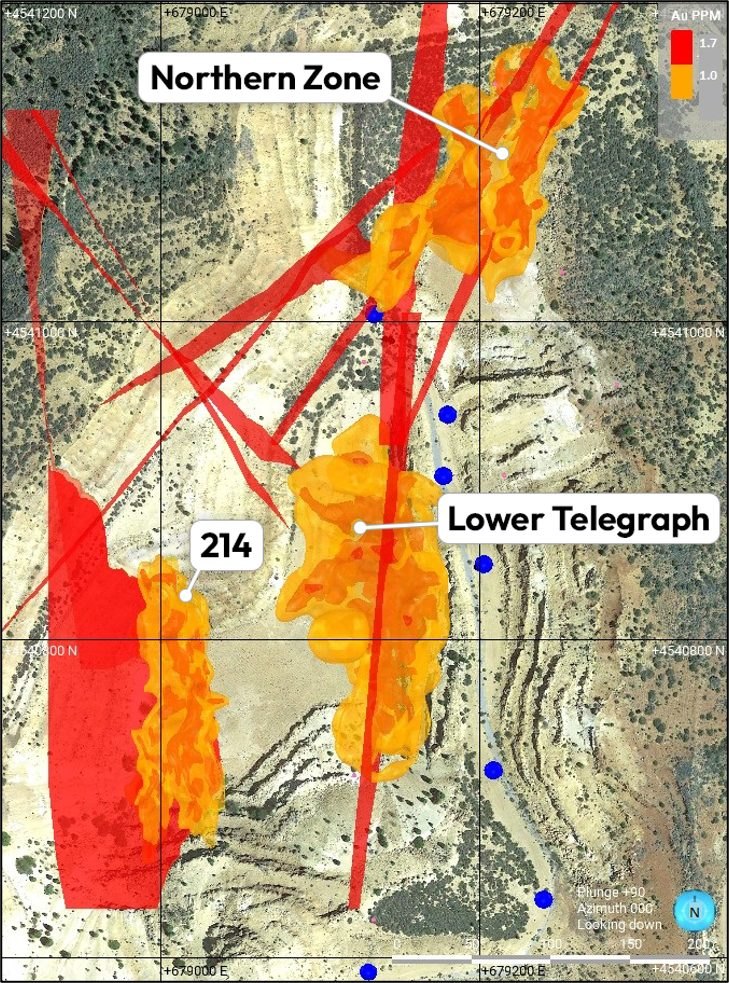
This is where geological theory is beginning to meet new evidence.
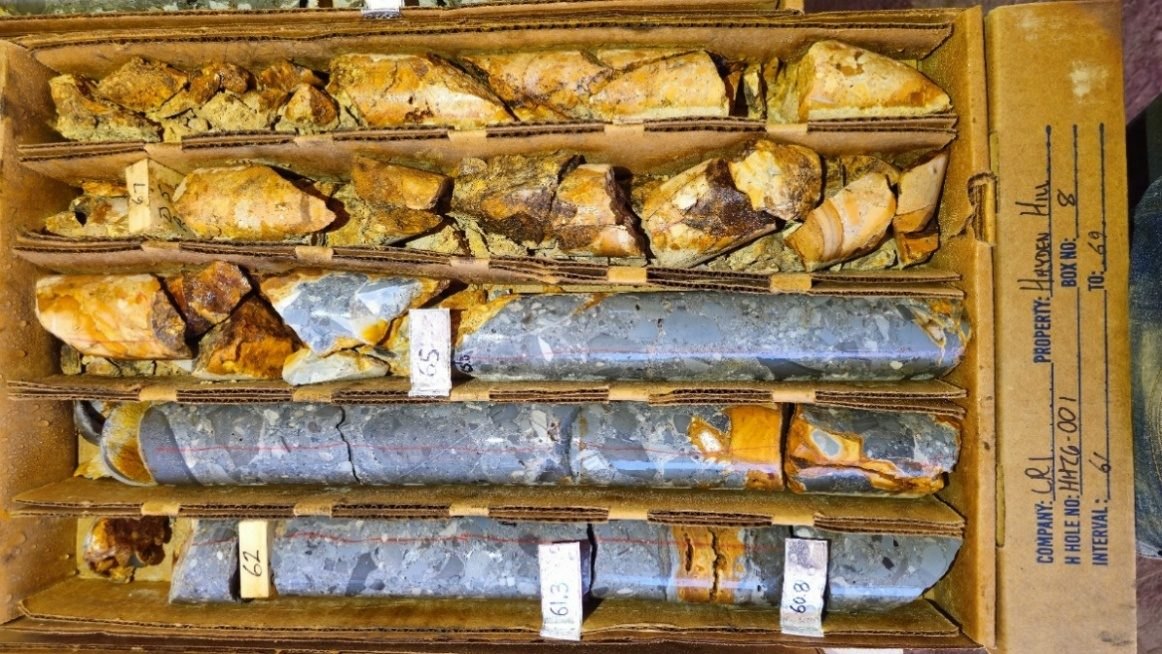
On October 19, 2026, Four Nines reported that drill hole HH26-003 intersected 80.1 metres averaging 1.08 g/t gold and 10 g/t silver.
The mineralization was found within strongly silicified volcanic rocks and hydrothermal breccias. Silicification occurs when silica-rich fluids alter the surrounding rock, a process commonly associated with hydrothermal activity.
Approximately 150 metres to the north, an earlier hole, HH26-001, encountered 31.9 metres averaging 1.05 g/t gold and 15 g/t silver.
For geologists, the significance extends beyond the individual gold grades.
Two drill holes encountering gold-bearing mineralization at different locations within the same interpreted corridor provide evidence that can be used to refine the company's understanding of the geological system.
That does not yet establish continuous mineralization between the holes, and the true thicknesses of the reported intersections remain unknown.
But it gives the geological team additional information about where gold occurs and how it relates to the surrounding structures.
Another hole, HH26-005, encountered approximately 58 metres of hydrothermal breccia exhibiting characteristics similar to the rocks associated with the mineralized intersections. Laboratory assays remained pending as of the October 19 announcement.
It's still early in the exploration process. The full dimensions, grades, and continuity of the Lower Telegraph Corridor have not been established, and the results do not demonstrate that additional mining would be economically viable.
Yet the broader question is an interesting one.
If Hayden Hill's historic operators concentrated on shallow gold deposits, how much did their drilling reveal about the structures responsible for forming those deposits?
And what might be learned by examining those structures with modern geological models and drilling techniques?
The Lower Telegraph Corridor is only the first of eight exploration zones identified by Four Nines. As the company continues investigating the property, each new drill hole has the potential to add another piece to its interpretation of how the system formed.
Whether those pieces ultimately reveal additional economically significant mineralization remains to be determined.
The Geological Story Is Still Being Written
The world's great epithermal gold deposits remind us that a gold discovery is often the result of a much larger natural process.
Long before the first prospectors arrived, heated water was circulating through underground fractures, transporting dissolved metals, and depositing gold wherever geological conditions allowed.
Over time, those processes created the veins, breccias, and mineralized zones that mining companies spend decades trying to understand.
At Midas, Sleeper, and Fruta del Norte, the results of those processes have supported substantial mining operations.
At Hayden Hill, historical production has already established that the geological system concentrated significant quantities of gold and silver.
What Four Nines is now trying to understand is how that system extends beyond the areas previously mined.
The early drilling results have provided new evidence, but many questions remain about the relationships between the property's mineralized structures and their potential extent.
Those are questions that cannot be answered by looking at historical production figures alone.
They require understanding what lies beneath the old workings, how different structures may be related, and why some portions of the geological system contain more gold than others.
And that is where the next chapter of Hayden Hill's exploration story begins.
After all, discovering where gold was deposited is one thing. Understanding the underground system that put it there may reveal where else to look.
Learn more about Four Nines Gold and its Hayden Hill Gold-Silver Project at www.fourninesgold.ca.
Sources and further reading
-
U.S. Geological Survey: Descriptive Models for Epithermal Gold-Silver Deposits - How epithermal systems form, their geological settings, and the different types of mineralization.
-
U.S. Geological Survey: Porphyry and Epithermal Mineral Deposits - Hydrothermal fluid movement, gold deposition, faults, and mineralized structures.
-
Hecla Mining: Nevada Exploration Projects - Midas historical production and ongoing exploration.
-
Paramount Gold Nevada: Sleeper Gold Mine Technical Report, June 17, 2026 - Historical production, mineralization and technical evaluation.
-
Lundin Gold: Mineral Reserves and Resources - Fruta del Norte district reserves effective December 31, 2025.
-
Four Nines Gold: Hayden Hill Gold-Silver Project - Property history, historical drilling and geological interpretation.
-
Four Nines Gold: October 1, 2026 Drilling Results - Initial drilling results from HH26-001.
-
Four Nines Gold: October 19, 2026 Drilling Results - Lower Telegraph Corridor exploration, HH26-003 results and outstanding assays.
Historical production and drilling figures for Hayden Hill are from previous operators and have not been verified by Four Nines Gold Inc.
Disclaimer
This content is published by Paydirt Capital, a brand of Apollo Shareholder Relations, for informational purposes only. It is not investment advice, a recommendation, or an offer or solicitation to buy or sell any security. Nothing here should be relied on for investment decisions. Readers should conduct their own due diligence and consult a registered investment advisor before making any investment.
Apollo Shareholder Relations provides paid investor relations, marketing, and communications services to publicly traded companies and may be compensated in cash or securities by companies in the sectors discussed. Where a company mentioned in this content is or becomes a client, Apollo may hold a financial interest in that company and its securities. This content is not independent research.
All facts and figures are drawn from public sources believed to be reliable, but accuracy is not guaranteed. Any forward-looking statements reflect current expectations only and actual outcomes may differ materially. Paydirt Capital and Apollo Shareholder Relations accept no liability for any loss arising from the use of this content.
The Weekly Dig
Find more good dirt in your inbox. The latest stories and ideas, free to subscribe.
Free to subscribe. Unsubscribe anytime. Sponsored content is disclosed.