Lithium Explained: Brine Versus Hard Rock and Why the Difference Matters
How lithium is produced from salt flat brines and spodumene rock, who produces what, and how cost, carbon and chemistry differ.
Key takeaways
- Brine lithium is evaporated in ponds for 12 to 24 months, while hard rock spodumene is mined, concentrated to 6% Li2O and roasted.
- In 2025, hard-rock-only countries supplied about 51% of mined lithium and Chile and Argentina's brines about 27%, per USGS data.
- About 6.7 tonnes of 6% spodumene concentrate are needed per tonne of lithium carbonate equivalent, before processing losses.
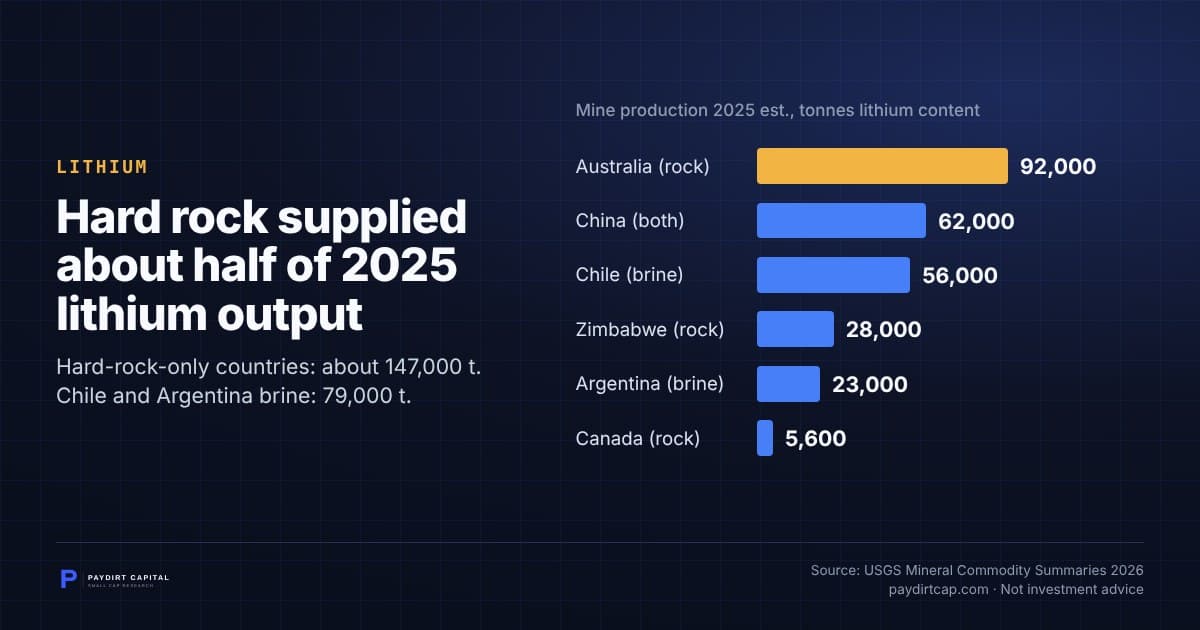
Lithium comes from two main sources: salty groundwater pumped from beneath dry lake beds, and hard rock mined from pegmatite deposits. Both end up as battery chemicals, but they take different routes, on different timelines, at different costs. In 2025, countries producing only from hard rock supplied roughly half of the world's mined lithium, according to USGS figures.
Brine: lithium from salt flats
Brine deposits sit under salt flats, or salars, mostly in Chile, Argentina and China. Producers pump the brine into large ponds and let the sun evaporate the water. That takes between 12 and 24 months depending on climate, according to a 2025 review in npj Materials Sustainability. Conventional evaporation recovers about 50% of the lithium in the brine.
The concentrated solution is then processed into lithium carbonate. It can be converted to lithium hydroxide in a second step.
Direct lithium extraction, or DLE, is a newer route. Instead of ponds, it uses chemical processes to pull lithium from brine. Rio Tinto says DLE can take the process from brine to lithium carbonate in about a day and recover around 80% to 90% of the lithium, but it needs a more complex plant and typically uses more energy than ponds.
Hard rock: lithium from spodumene
Hard rock lithium mostly comes from spodumene, a mineral found in pegmatites. It is mined in open pits and underground, the way many other metals are. Australia is the largest hard rock producer. Zimbabwe, Brazil, Mali and Canada follow among countries that produce only from rock, and China also runs nine mineral operations, per the USGS.
The steps:
- Mine and crush the ore.
- Concentrate it to about 6% lithium oxide (Li2O). This is the "SC6" spodumene concentrate that trades internationally.
- Roast the concentrate in a rotary kiln at 1,040 to 1,100 degrees Celsius, per the npj Materials Sustainability review, then leach and refine it.
Spodumene can be converted straight into lithium hydroxide. That matters because nickel-rich cathodes, with nickel content above 60%, prefer hydroxide, according to BNP Paribas Asset Management.
Who produces what
USGS estimates for 2025, in tonnes of lithium content, published February 2026. Totals exclude US production, which is withheld.
| Country | Main source | 2025 production (est.) | Reserves |
|---|---|---|---|
| Australia | Hard rock | 92,000 | 8,400,000 |
| China | Both (9 mineral, 6 brine operations) | 62,000 | 4,600,000 |
| Chile | Brine | 56,000 | 9,200,000 |
| Zimbabwe | Hard rock | 28,000 | 500,000 |
| Argentina | Brine | 23,000 | 4,400,000 |
| Brazil | Hard rock | 12,000 | 540,000 |
| Mali | Hard rock | 9,400 | 370,000 |
| Canada | Hard rock | 5,600 | 1,600,000 |
| World total (rounded) | 290,000 | 37,000,000 |
Adding up the hard-rock-only countries (Australia, Zimbabwe, Brazil, Mali, Canada and Portugal at 380 tonnes) gives about 147,000 tonnes, roughly 51% of the world total. The two brine producers, Chile and Argentina, total 79,000 tonnes, about 27%. China, which does both, supplied the rest along with smaller producers. World output rose 31% in 2025, from 222,000 tonnes in 2024, according to the USGS.
Why the difference matters
Cost. Brine is generally the lower-cost route because it uses less energy. The npj review puts operating costs at about US$3,300 to $4,900 per tonne of lithium carbonate equivalent (LCE) for solar evaporation and US$3,600 to $8,000 for hard rock.
Carbon. BNP Paribas Asset Management cites about 15 tonnes of CO2 per tonne of lithium refined from hard rock in China, against about 5 tonnes from brine.
Speed. Evaporation ponds take 12 to 24 months to deliver concentrated brine, so conventional brine output cannot be adjusted quickly. DLE shortens that step to about a day, which is a large part of its appeal.
Recovery. Ponds recover about 50% of the lithium in the brine. DLE recovers 80% to 90% by Rio Tinto's figures. On the same resource, that is the difference between recovering roughly half the lithium and recovering most of it.
Product. Brine naturally yields carbonate. Hard rock can go directly to hydroxide. Which chemistry battery makers want affects which source is favoured.
Prices have been volatile. The USGS reports the average US contract price for battery-grade lithium carbonate at $63,700 per tonne in 2022 and $9,000 in 2025, both in real terms. The IEA reported that lithium prices more than doubled between January 2025 and April 2026.
The math: from spodumene to lithium carbonate
Chemistry sets the conversion ratios. Using standard atomic weights:
- Lithium makes up about 46.5% of lithium oxide by weight, so a 6% Li2O concentrate holds about 2.79% lithium, or 27.9 kg per tonne.
- One tonne of lithium equals about 5.32 tonnes of lithium carbonate, so 27.9 kg of lithium is about 148 kg of LCE.
- That means about 6.7 tonnes of SC6 concentrate per tonne of LCE, before any processing losses.
Using USGS November 2025 prices, spodumene at about $970 per tonne and Chinese spot carbonate at about $10,300: 6.7 x $970 is about $6,500 of concentrate for a product worth about $10,300. The difference has to cover roasting, reagents, energy, freight, processing losses and the converter's margin. For a brine producer, the equivalent input is pumped brine and pond time, which is one reason brine sits lower on the cost range cited above.
Canada's position
Natural Resources Canada reports that Canada produced an estimated 5,983 tonnes of lithium in 2024, about 2.5% of world output, from two hard rock mines, one in Manitoba and one in Quebec. NRCan also estimates about 2.5 million tonnes of lithium in hard rock resources and about 4.0 million tonnes in brines in Alberta and Saskatchewan. NRCan puts Canada's proven reserves at 1.3 million tonnes, while the USGS's February 2026 table, after revisions, shows 1.6 million. The two agencies use different dates and methods, so figures differ. Canada has no commercial brine production; its output today is all hard rock. For how deposits are reported, see what NI 43-101 means.
What to watch
- The USGS Mineral Commodity Summaries 2027, expected early in 2027.
- NRCan's annual lithium facts update.
- Commercial start-ups of DLE plants and their reported recovery rates.
- IEA Global Critical Minerals Outlook updates on lithium supply and conversion capacity.
Sources
- USGS Mineral Commodity Summaries 2026: Lithium
- Natural Resources Canada: Lithium facts
- npj Materials Sustainability: Lithium resources and novel strategies for their extraction and purification
- Rio Tinto: What is direct lithium extraction?
- BNP Paribas Asset Management: What you need to know about lithium
- IEA: Global Critical Minerals Outlook 2026, Executive Summary
Frequently asked questions
What is the difference between brine and hard rock lithium?
Brine lithium is pumped from salty groundwater under salt flats and concentrated in evaporation ponds for 12 to 24 months, recovering about 50% of the lithium. Hard rock lithium comes from spodumene, which is mined, concentrated to about 6% lithium oxide and roasted at over 1,000 degrees Celsius. Brine yields carbonate; spodumene can go directly to hydroxide.
Which countries produce the most lithium?
According to USGS estimates for 2025, Australia produced about 92,000 tonnes of lithium content, China 62,000, Chile 56,000, Zimbabwe 28,000 and Argentina 23,000. World output, excluding withheld US data, rose 31% to about 290,000 tonnes. Chile has the largest reserves at 9.2 million tonnes, followed by Australia at 8.4 million.
What is direct lithium extraction?
Direct lithium extraction, or DLE, uses chemical processes to pull lithium out of brine instead of evaporating it in ponds. Rio Tinto says DLE can take brine to lithium carbonate in about a day and recover around 80% to 90% of the lithium, compared with about 50% for ponds, but it needs more complex plants and typically more energy.
Related reading
Disclaimer
This content is published by Paydirt Capital, a brand of Apollo Shareholder Relations, for informational purposes only. It is not investment advice, a recommendation, or an offer or solicitation to buy or sell any security. Nothing here should be relied on for investment decisions. Readers should conduct their own due diligence and consult a registered investment advisor before making any investment.
Apollo Shareholder Relations provides paid investor relations, marketing, and communications services to publicly traded companies and may be compensated in cash or securities by companies in the sectors discussed. Where a company mentioned in this content is or becomes a client, Apollo may hold a financial interest in that company and its securities. This content is not independent research.
All facts and figures are drawn from public sources believed to be reliable, but accuracy is not guaranteed. Any forward-looking statements reflect current expectations only and actual outcomes may differ materially. Paydirt Capital and Apollo Shareholder Relations accept no liability for any loss arising from the use of this content.
The Weekly Dig
Find more good dirt in your inbox. The latest stories and ideas, free to subscribe.
Free to subscribe. Unsubscribe anytime. Sponsored content is disclosed.