Indigenous Equity in Canadian Resource Projects: IBAs and Loan Guarantees
How impact benefit agreements, equity stakes and federal and provincial loan guarantee programs work in Canadian resource projects, with dated deals and figures.
Key takeaways
- More than 500 mining-Indigenous relationship agreements are in place across Canada, covering training, jobs, contracting, environment and community investment.
- Federal, Alberta, Ontario and BC loan guarantee programs total $17 billion of capacity to help Indigenous communities buy equity stakes.
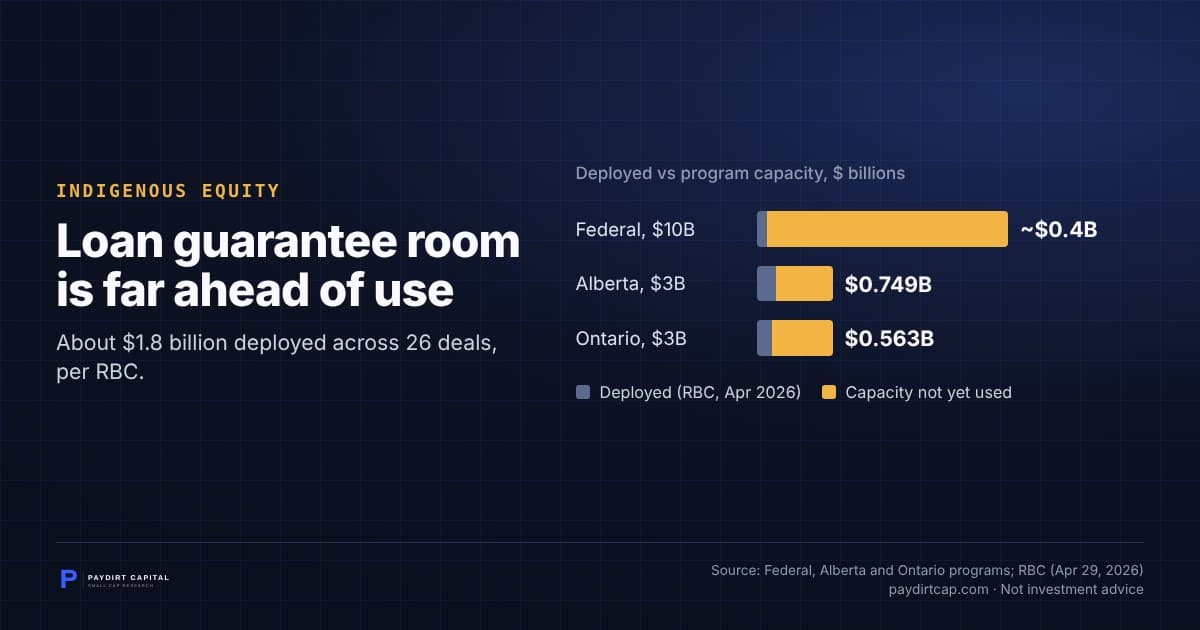
- RBC counted about $1.8 billion deployed across 26 deals as of April 2026, roughly 11% of combined program authority.
Indigenous participation in Canadian resource projects has moved from negotiated benefits toward direct ownership. Impact benefit agreements still set the basic terms, and there are more than 500 of them in mining alone. What has changed is financing: federal and provincial loan guarantee programs now back more than $17 billion of borrowing capacity so Indigenous communities can buy equity stakes.
Impact benefit agreements: the base layer
An impact benefit agreement (IBA) is a legally binding contract between a resource company and one or more Indigenous communities. The Mining Association of Canada describes these relationship agreements as setting out how a company and a community will work together. Modern agreements typically cover:
- Education and training
- Employment
- Business development and contracting
- Environmental stewardship
- Community investment
According to the Mining Association of Canada, there are more than 500 such agreements in place across Canada. Most are confidential at the request of the Indigenous party, so the financial terms of any single agreement are usually not public. Natural Resources Canada keeps a database of signatories, agreement types and projects for active and expired agreements.
For how Indigenous consultation fits into project timelines, see how long it takes to build a mine in Canada.
From benefits to ownership
An IBA pays out while a project runs. An equity stake gives a community a share of the asset itself and of its cash flow. The obstacle has been capital. The two deals below cost $1.12 billion and about $715 million.
A loan guarantee solves part of that. The government does not lend the money. It backs a commercial loan, so the community can borrow at better terms than it could alone. British Columbia's program puts it simply: "A provincial equity loan guarantee is not a loan or a grant, but a financial backstop that enables applicants to secure commercial financing."
The guarantee programs
| Program | Capacity | Key dates and terms |
|---|---|---|
| Federal Indigenous Loan Guarantee Program (Canada Indigenous Loan Guarantee Corporation) | $10 billion | Doubled from $5 billion on March 21, 2025, and widened beyond energy and natural resources to infrastructure, transportation and trade |
| Alberta Indigenous Opportunities Corporation | $3 billion | Raised from $1 billion to $2 billion for 2023 to 2024 and $3 billion for 2024 to 2025, announced November 1, 2023 |
| Ontario Indigenous Opportunities Financing Program | $3 billion | Tripled from $1 billion in the 2025 budget; running since 2009 as the Aboriginal Loan Guarantee Program; administered by the Building Ontario Fund since October 1, 2025 |
| British Columbia First Nations Equity Financing Program | $1 billion | Applications opened June 16, 2026; guarantees of $5 million to $400 million, up to 20% of a project's capital cost |
Ontario's expansion, announced May 21, 2025, extended eligibility to mining, critical minerals, resource development, energy and pipelines. The same announcement included a $70 million Indigenous Participation Fund over four years, for capacity building and participation in regulatory processes, and $10 million for scholarships over three years.
BC's program covers natural resources, energy, tourism, agriculture and aquaculture. It excludes housing, gaming, forest tenures and exploration. A portion of the $1 billion is reserved for small and medium projects with capital costs of $25 million to $125 million. Applicants pay an initial fee based on the loan principal, plus annual monitoring and administration fees on the remaining balance. Applications are taken on a rolling basis until the guarantee room is fully allocated.
Alberta's corporation guarantees loans for projects in natural resources, agriculture, transportation and telecommunications.
Two deals that show the structure
Enbridge, Alberta oil sands pipelines (September 28, 2022). Twenty-three First Nation and Métis communities agreed to buy an 11.57% non-operating interest in seven Enbridge pipelines in the Athabasca region for $1.12 billion. The Alberta Indigenous Opportunities Corporation provided a $250 million loan guarantee.
Enbridge, Westcoast gas pipeline (May 15, 2025). The federal program issued its first guarantee: $400 million for the Stonlasec8 Indigenous Alliance, representing 36 First Nations in BC. The group is buying a 12.5% interest in Enbridge's Westcoast natural gas pipeline system for about $715 million.
The math: guarantees versus deployment
In the Westcoast deal, the $400 million guarantee backs about 56% of the roughly $715 million purchase price ($400 million / $715 million). In the 2022 Alberta deal, the $250 million guarantee was about 22% of the $1.12 billion price. The guarantee does not have to cover the whole purchase price.
At the program level, capacity is far ahead of use. In an April 29, 2026 report, RBC counted 26 completed deals across four guarantee programs, with about $1.8 billion deployed. That is roughly 11% of the more than $17 billion in combined program authority. RBC's breakdown:
- Federal: 2 transactions, with about $400 million deployed.
- Alberta: 9 deals totalling $749 million since 2019.
- Ontario: 13 deals valued at $563 million since 2009.
- Saskatchewan: 2 deals worth $107 million.
RBC attributed the low use to deal complexity and economic headwinds rather than program failure. The four large programs in the table above alone add up to $17 billion ($10 billion + $3 billion + $3 billion + $1 billion).
What to watch
- New guarantees announced by the Canada Indigenous Loan Guarantee Corporation, now that it covers sectors beyond energy and resources.
- The first guarantees issued under BC's First Nations Equity Financing Program, which opened June 16, 2026.
- Deals under Ontario's program since eligibility widened to mining and critical minerals.
- Company disclosures of Indigenous equity partners in major project filings and press releases.
- Updates to NRCan's database of Indigenous mining agreements.
Sources
- Mining Association of Canada: Mining-Indigenous relationship agreements
- Canada Development Investment Corporation: Changes to the Indigenous Loan Guarantee Program (March 21, 2025)
- Canada Development Investment Corporation: Federal Indigenous Loan Guarantee Program celebrates first loan guarantee (May 15, 2025)
- RBC: Nations Building, assessing Indigenous loan guarantee programs (April 29, 2026)
- Alberta Indigenous Opportunities Corporation: Loan guarantee capacity to increase to $3 billion (November 1, 2023)
- Building Ontario Fund: Indigenous Opportunities Financing Program fact sheet
- McMillan LLP: Now open, British Columbia's $1 billion First Nations Equity Financing Program
- Enbridge: Indigenous communities and Enbridge announce landmark equity partnership (September 28, 2022)
Frequently asked questions
What is an impact benefit agreement in mining?
An impact benefit agreement is a legally binding contract between a resource company and one or more Indigenous communities that sets out how they will work together. Modern agreements typically cover education and training, employment, business development, environmental stewardship and community investment. The Mining Association of Canada says more than 500 are in place, most kept confidential.
How does the federal Indigenous Loan Guarantee Program work?
The program, run by the Canada Indigenous Loan Guarantee Corporation, backs commercial loans that Indigenous groups use to buy equity in projects. It was doubled to $10 billion on March 21, 2025, and widened beyond energy and resources. Its first guarantee, announced May 15, 2025, was $400 million for 36 BC First Nations buying into Enbridge's Westcoast pipeline.
Which provinces have Indigenous loan guarantee programs?
Alberta's Indigenous Opportunities Corporation has $3 billion of capacity. Ontario's Indigenous Opportunities Financing Program was tripled to $3 billion in 2025 and dates to 2009. British Columbia's $1 billion First Nations Equity Financing Program opened June 16, 2026. RBC also lists programs in Saskatchewan and Manitoba.
Related reading
Disclaimer
This content is published by Paydirt Capital, a brand of Apollo Shareholder Relations, for informational purposes only. It is not investment advice, a recommendation, or an offer or solicitation to buy or sell any security. Nothing here should be relied on for investment decisions. Readers should conduct their own due diligence and consult a registered investment advisor before making any investment.
Apollo Shareholder Relations provides paid investor relations, marketing, and communications services to publicly traded companies and may be compensated in cash or securities by companies in the sectors discussed. Where a company mentioned in this content is or becomes a client, Apollo may hold a financial interest in that company and its securities. This content is not independent research.
All facts and figures are drawn from public sources believed to be reliable, but accuracy is not guaranteed. Any forward-looking statements reflect current expectations only and actual outcomes may differ materially. Paydirt Capital and Apollo Shareholder Relations accept no liability for any loss arising from the use of this content.
The Weekly Dig
Find more good dirt in your inbox. The latest stories and ideas, free to subscribe.
Free to subscribe. Unsubscribe anytime. Sponsored content is disclosed.