Platinum Group Metals Explained: Platinum, Palladium and Rhodium
Where platinum, palladium and rhodium are mined, what they are used for and why two countries and one industry drive most of the market.
Key takeaways
- South Africa produced about 71% of mined platinum in 2025, and Russia and South Africa together about 81% of palladium, per USGS estimates.
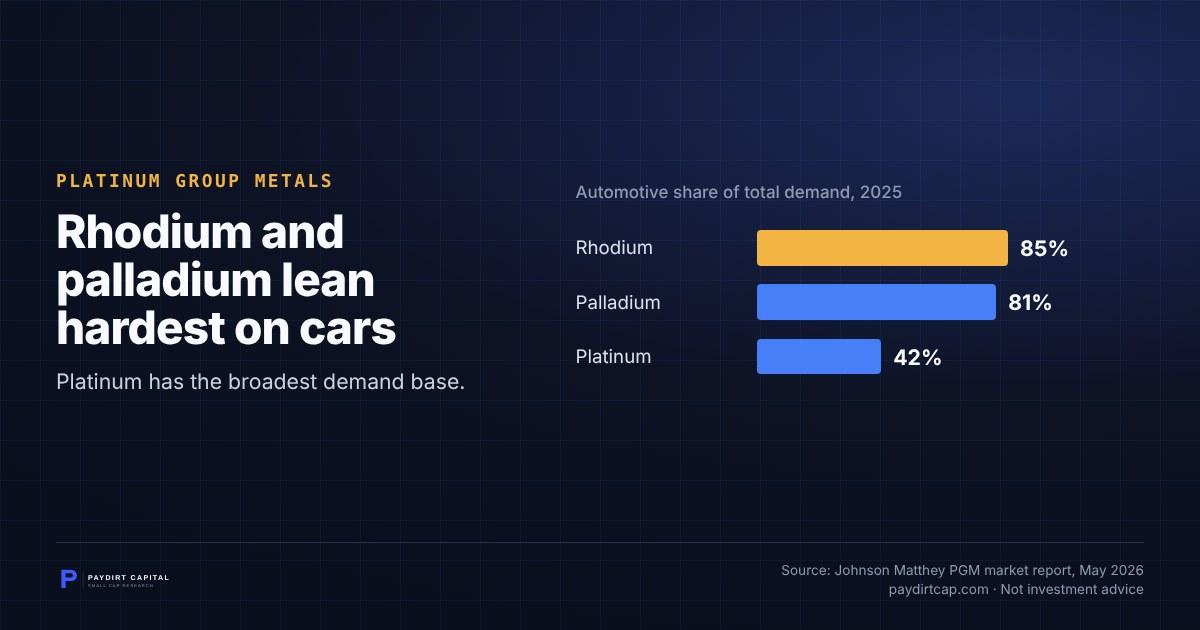
- Autocatalysts took 42% of platinum, 81% of palladium and 85% of rhodium demand in 2025, according to Johnson Matthey.
- Rhodium's annual average price fell about 77% from 2021 to 2024, showing how volatile these thin markets can be.
Platinum, palladium and rhodium are three of the six platinum group metals, and most of the world's supply comes from two countries: South Africa and Russia. Their biggest single use is in vehicle catalytic converters. That combination, concentrated supply and one dominant end use, explains most of what moves these markets.
Six metals, three that matter most
The US Geological Survey groups six elements as platinum group metals (PGMs): palladium, platinum, iridium, osmium, rhodium and ruthenium. They occur together in the same ore bodies. Platinum, palladium and rhodium are the three used in autocatalysts, and Johnson Matthey's annual market report tracks them as the "autocatalyst PGM."
They are rarely mined one at a time. A South African platinum mine also produces palladium and rhodium. In Canada, PGMs come from nickel-copper mines such as those in the Sudbury area, and most Russian output comes from Norilsk Nickel, according to Johnson Matthey. That means output of any one metal does not respond neatly to its own price.
Where they come from
The USGS estimates world mine production in 2025 at 170,000 kilograms of platinum and 190,000 kilograms of palladium. Here is how it breaks down.
| Country | Platinum 2025e (kg) | Palladium 2025e (kg) |
|---|---|---|
| South Africa | 120,000 | 70,000 |
| Russia | 20,000 | 84,000 |
| Zimbabwe | 18,000 | 15,000 |
| Canada | 5,000 | 16,000 |
| United States | 1,800 | 6,200 |
| Other | 3,900 | 2,900 |
| World (rounded) | 170,000 | 190,000 |
South Africa produced about 71% of the world's mined platinum in 2025, by our arithmetic from the USGS table. For palladium, Russia and South Africa together produced about 81%. The USGS puts world PGM reserves at more than 76 million kilograms, with the largest resources and reserves in South Africa's Bushveld Complex.
Rhodium is even more concentrated. Johnson Matthey's May 2026 report estimates 2025 primary rhodium supply at 701,000 ounces, of which 566,000 came from South Africa.
Supply is fragile. The USGS says South African output fell an estimated 9% in 2025 because of lower palladium prices, the cost of deep-level mining and electricity disruptions. Russian output fell an estimated 6%. Johnson Matthey expects Russian palladium output in 2026 to drop to its lowest level in at least two decades.
What they are used for
Catalytic converters dominate. Johnson Matthey's figures for 2025 show how much each metal depends on the automotive sector.
| Metal (2025, thousand oz) | Automotive demand | Total demand | Automotive share |
|---|---|---|---|
| Platinum | 3,329 | 8,019 | 42% |
| Palladium | 8,227 | 10,140 | 81% |
| Rhodium | 899 | 1,063 | 85% |
Platinum has the broadest demand base. Beyond autocatalysts, Johnson Matthey counts 2,627,000 ounces of industrial demand in 2025, 1,507,000 ounces of jewellery and 556,000 ounces of investment. Industrial uses include chemical catalysts such as paraxylene production, glass making and petroleum refining.
Palladium is overwhelmingly an autocatalyst metal. The USGS notes it replaced platinum in most gasoline-engine catalytic converters because it was historically cheaper. Jewellery demand is negligible at 83,000 ounces.
Rhodium is the most auto-dependent of the three. Outside autos it is used in chemical catalysts such as acetic acid production and in some specialist and display glass, according to Johnson Matthey.
Substitution runs both ways. The USGS says about 25% of palladium can routinely be substituted for platinum in diesel catalysts, and as much as 50% in some applications. When one metal gets expensive relative to another, automakers can adjust loadings. The USGS cited substitution of platinum in automobile catalysts as one factor behind 2025 price increases.
Price swings are the norm
Thin markets and concentrated supply make for large moves. USGS annual average prices show the range.
| Year | Platinum ($/oz) | Palladium ($/oz) | Rhodium ($/oz) |
|---|---|---|---|
| 2021 | 1,094 | 2,419 | 20,254 |
| 2022 | 967 | 2,134 | 15,585 |
| 2023 | 973 | 1,352 | 6,661 |
| 2024 | 961 | 995 | 4,660 |
| 2025e | 1,200 | 1,100 | 5,800 |
Rhodium's annual average fell about 77% from 2021 to 2024. Johnson Matthey reports rhodium then peaked at a three-year high of US$12,000 in late February 2026.
Recycling is the other supply lever. The USGS estimates about 140,000 kilograms of palladium and platinum were recovered globally from scrap in 2025. Johnson Matthey counted 3,135,000 ounces of secondary palladium supply in 2025, from recycled autocatalysts, jewellery, electronics and pollution control equipment.
Thin markets, tight borrowing
PGM markets are small enough that physical flows can squeeze them. Johnson Matthey describes what happened in platinum in 2025. The risk of US tariffs on precious metals drew a large influx of platinum into NYMEX warehouses in the first quarter, while a surge in Chinese jewellery fabrication pulled more metal east in April and May. Short-term platinum borrowing rates rose from 3% in late 2024 to around 10% in the first quarter of 2025, then above 20% in mid-year.
North American supply is small by comparison. The USGS says one company in Montana mined and processed PGMs in the United States in 2025, and US palladium and platinum output fell about 40% that year because one operation stayed on care-and-maintenance. The USGS puts US net import reliance for platinum at 89% of apparent consumption in 2025, and 57% for palladium.
The electric vehicle question
Battery electric vehicles have no exhaust system and no catalytic converter. That is the core long-term risk to autocatalyst demand. Johnson Matthey wrote in May 2026 that investor sentiment revived in 2025 as it became clear that battery EV adoption would be substantially slower than earlier predictions in all regions except China. Hybrids still carry catalysts.
Forecasters differ on the balance. Johnson Matthey expects platinum to post a fourth straight deficit in 2026, while palladium and rhodium could move into small surpluses. The World Platinum Investment Council, in its Q1 2026 Platinum Quarterly published May 18, 2026, forecast a 2026 platinum deficit of 297,000 ounces after 1.1 million ounces in 2025. It projected total 2026 demand of 7,674,000 ounces, with bar and coin investment up 27% to 718,000 ounces and industrial demand up 9% to 2,238,000 ounces. Johnson Matthey, by contrast, expects total demand for platinum to fall 8% in 2026 and palladium 9%. Those are their projections, not certainties.
For another metal whose demand splits between industry and investment, see our piece on silver's industrial demand and supply deficit.
What to watch
- The World Platinum Investment Council's quarterly Platinum Quarterly releases.
- Johnson Matthey's PGM market report, published each May.
- South African PGM production data from Statistics South Africa and producer quarterly reports.
- Global light vehicle production and battery EV sales share, especially outside China.
- The USGS Mineral Commodity Summaries, published each January.
Sources
- US Geological Survey, Mineral Commodity Summaries 2026: Platinum-Group Metals
- Johnson Matthey, PGM Market Report May 2026
- Johnson Matthey, Johnson Matthey publishes 2026 PGM market report (May 14, 2026)
- World Platinum Investment Council, Q1 2026 Platinum Quarterly release (May 18, 2026)
- World Platinum Investment Council, Platinum Quarterly
Frequently asked questions
What are the six platinum group metals?
The US Geological Survey lists six platinum group metals: palladium, platinum, iridium, osmium, rhodium and ruthenium. They occur together in the same ore bodies. Platinum, palladium and rhodium are the three used in vehicle catalytic converters and are the most widely followed by investors and industry.
Where do platinum and palladium come from?
USGS estimates show South Africa mined 120,000 of the world's 170,000 kilograms of platinum in 2025. Russia led palladium with 84,000 kilograms, followed by South Africa at 70,000, out of a world total of 190,000 kilograms. Zimbabwe, Canada and the United States produce smaller amounts. The largest reserves are in South Africa's Bushveld Complex.
What is palladium mainly used for?
Palladium is mainly used in catalytic converters. Johnson Matthey counted 8.227 million ounces of automotive palladium demand in 2025 out of 10.14 million ounces in total, about 81%. The USGS notes palladium replaced platinum in most gasoline-engine converters because it was historically cheaper. Jewellery demand for palladium is negligible.
Related reading
Disclaimer
This content is published by Paydirt Capital, a brand of Apollo Shareholder Relations, for informational purposes only. It is not investment advice, a recommendation, or an offer or solicitation to buy or sell any security. Nothing here should be relied on for investment decisions. Readers should conduct their own due diligence and consult a registered investment advisor before making any investment.
Apollo Shareholder Relations provides paid investor relations, marketing, and communications services to publicly traded companies and may be compensated in cash or securities by companies in the sectors discussed. Where a company mentioned in this content is or becomes a client, Apollo may hold a financial interest in that company and its securities. This content is not independent research.
All facts and figures are drawn from public sources believed to be reliable, but accuracy is not guaranteed. Any forward-looking statements reflect current expectations only and actual outcomes may differ materially. Paydirt Capital and Apollo Shareholder Relations accept no liability for any loss arising from the use of this content.
The Weekly Dig
Find more good dirt in your inbox. The latest stories and ideas, free to subscribe.
Free to subscribe. Unsubscribe anytime. Sponsored content is disclosed.