Rates Turn Up: What the Fed and Bank of Canada Hikes Mean for Small Caps
Both the US Federal Reserve and the Bank of Canada raised rates this autumn, their first increases since 2023. What changed, what is scheduled next, and how higher rates reach small companies.
Key takeaways
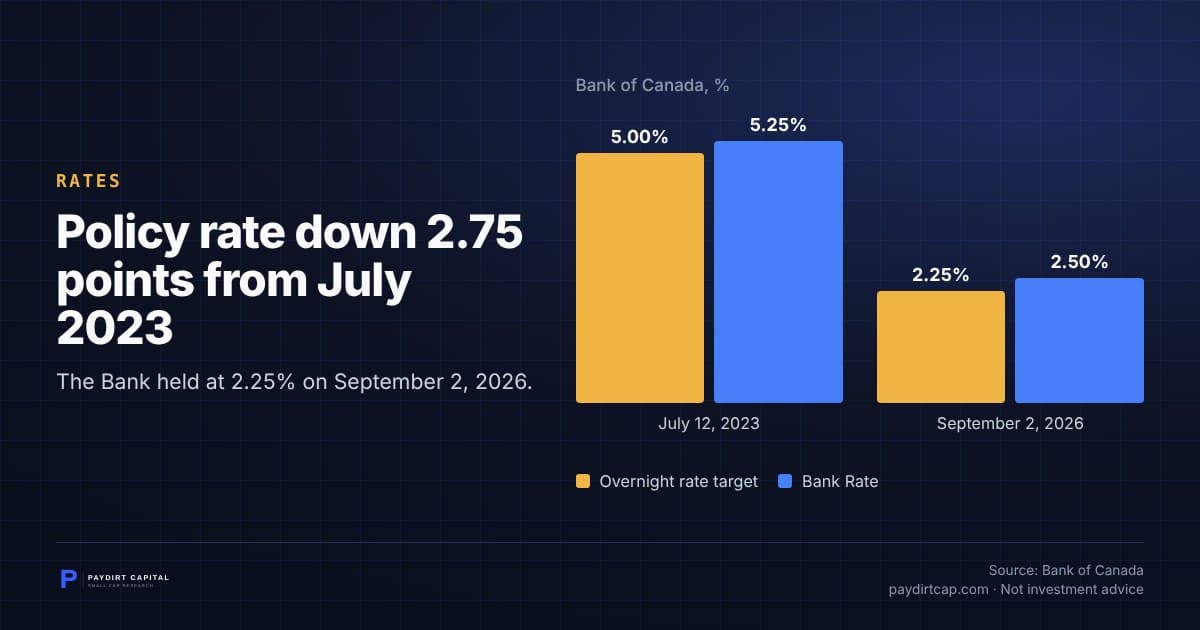
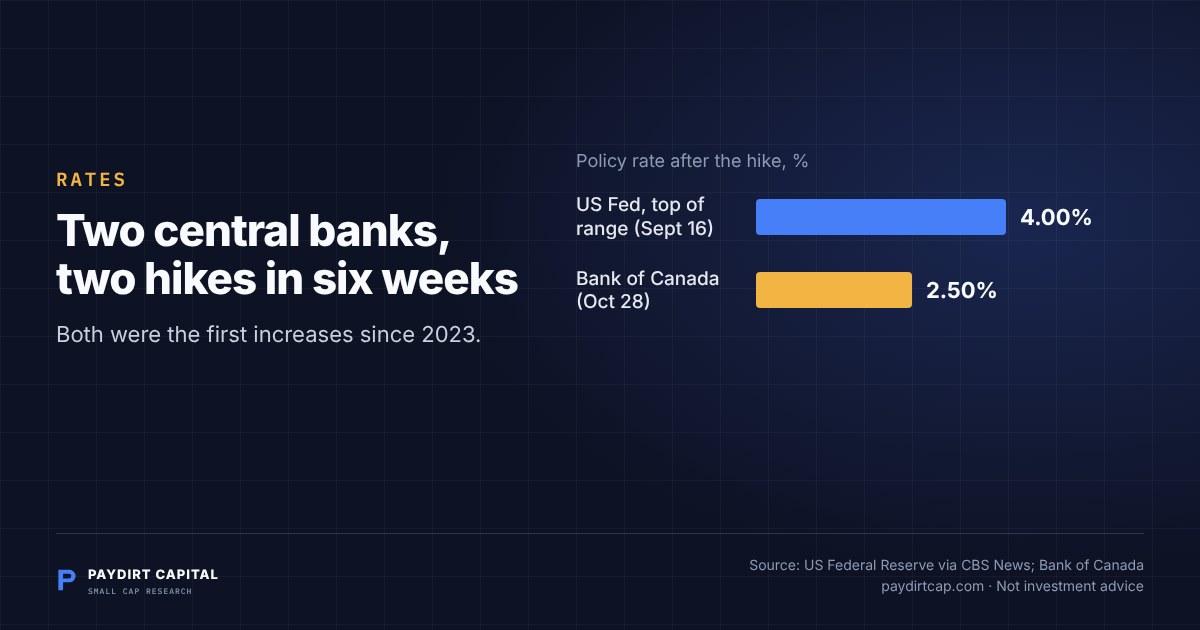
- The US Federal Reserve raised its target range to 3.75% to 4% on September 16, 2026, its first increase since 2023. The Bank of Canada raised its policy rate to 2.5% on October 28, its first since July 2023.
- A hotter than expected US inflation report on November 10 put a December Fed increase in play, and Fed governor Christopher Waller said he would back a 50 basis point move if inflation stayed high.
- Higher rates reach small caps through the cost of borrowing, the price of equity financing and the discount rate investors apply to future earnings. They also raise the interest earned on cash held by companies that are not yet producing.
Two hikes in six weeks
At the start of 2026 many economists expected central banks to cut rates through the year. By the autumn both the US Federal Reserve and the Bank of Canada had moved the other way.
| Central bank | Decision | Date | Note |
|---|---|---|---|
| US Federal Reserve | Target range raised 0.25 points to 3.75% to 4% | September 16, 2026 | First increase since 2023; vote 12 to 0 |
| Bank of Canada | Policy rate raised 0.25 points to 2.5% | October 28, 2026 | First increase since July 2023 |
The Fed's September decision came as the war with Iran pushed up fuel prices. Chair Kevin Warsh described the unanimous vote as "sober," and the Fed's projections signalled one more increase in 2026. The Bank of Canada's October 28 release set the Bank Rate at 2.75% and the deposit rate at 2.45%.
What has happened since
On November 10, US consumer prices for October came in hotter than expected. Fed governor Christopher Waller said he would support a 50 basis point increase in December if inflation stayed high, which would be the Fed's largest move since 2022. PIMCO, in a note after the report, said its baseline was not yet a 50 point move but that it now expected 25 point increases in both December and January.
In Canada, CIBC senior economist Andrew Grantham expected the Bank of Canada to pause on December 9 and raise again in January. Those are forecasts, not decisions.
The dates that matter:
- December 9, 2026: Bank of Canada rate announcement.
- December 2026: US Federal Reserve meeting.
- January 27, 2027: Bank of Canada Monetary Policy Report.
Our explainer on how the Bank of Canada sets interest rates covers the process and schedule.
How higher rates reach small companies
Interest rates touch small-cap companies in four practical ways:
- Borrowing costs. Companies with floating-rate debt pay more as rates rise. Development-stage miners financing a build with project debt face higher interest in their models.
- Equity financing. Higher rates make safe returns more attractive, which can thin the pool of investors willing to fund early-stage companies. Raising money can take a lower share price or more warrants.
- Discount rates. Valuation methods that discount future cash flows, such as the net present value in a mining study, use a discount rate. Higher market rates can push investors toward higher discount rates, which lowers the present value of distant cash flows.
- Interest on cash. The other side: exploration companies holding cash from a financing earn more interest on it while it sits in the treasury.
The effect is uneven. A profitable company with no debt feels higher rates mainly through valuation. A pre-revenue company that needs to raise money every year feels them through financing.
The commodity link
For resource companies, rates also work through commodity prices. Gold pays no income, so higher rates raise the cost of holding it, and a stronger US dollar tends to weigh on dollar-priced metals. Gold fell to its lowest price since September 2025 on November 18, 2026, as reported by Nation Thailand, with the US dollar at a 19-month high on expectations of further increases.
What to watch
- The Bank of Canada's December 9 statement, for whether it pauses or raises again.
- The Fed's December decision and the size of any move.
- US and Canadian inflation data in December.
- Financing terms on new small-cap raises: price, discount and warrant coverage.
Sources
- CBS News, Federal Reserve raises interest rates for the first time since 2023 (September 16, 2026)
- Virginia Mercury (States Newsroom), Fed raises interest rates for first time in 3 years (September 17, 2026)
- Bank of Canada, Bank of Canada raises the policy rate by 25 basis points to 2½% (October 28, 2026)
- The National, Hot US inflation report seals Federal Reserve rate increase (November 10, 2026)
- PIMCO, Inflation is sticky, but this isn't 2022 all over again (November 2026)
- The Canadian Press via insauga, Bank of Canada delivers first interest rate hike in three years (October 28, 2026)
- Nation Thailand, Gold hits 14-month low on Nov 18 as US dollar strengthens (November 19, 2026)
Frequently asked questions
When is the next Bank of Canada rate decision?
The Bank of Canada's next scheduled announcement is December 9, 2026, and its next Monetary Policy Report is due January 27, 2027, according to its October 28, 2026 release.
Why did central banks raise rates in 2026?
Both the Federal Reserve and the Bank of Canada pointed to higher energy prices tied to the war in the Middle East as a source of inflation pressure. The Fed raised in September after concluding the energy shock was no longer temporary, and the Bank of Canada followed on October 28.
Related reading
Disclaimer
This content is published by Paydirt Capital, a brand of Apollo Shareholder Relations, for informational purposes only. It is not investment advice, a recommendation, or an offer or solicitation to buy or sell any security. Nothing here should be relied on for investment decisions. Readers should conduct their own due diligence and consult a registered investment advisor before making any investment.
Apollo Shareholder Relations provides paid investor relations, marketing, and communications services to publicly traded companies and may be compensated in cash or securities by companies in the sectors discussed. Where a company mentioned in this content is or becomes a client, Apollo may hold a financial interest in that company and its securities. This content is not independent research.
All facts and figures are drawn from public sources believed to be reliable, but accuracy is not guaranteed. Any forward-looking statements reflect current expectations only and actual outcomes may differ materially. Paydirt Capital and Apollo Shareholder Relations accept no liability for any loss arising from the use of this content.
The Weekly Dig
Find more good dirt in your inbox. The latest stories and ideas, free to subscribe.
Free to subscribe. Unsubscribe anytime. Sponsored content is disclosed.