Graphite, Nickel and the Battery Supply Chain in Canada
Where graphite and nickel fit in a battery, how much Canada produces, and why most processing still happens in China and Indonesia.
Key takeaways
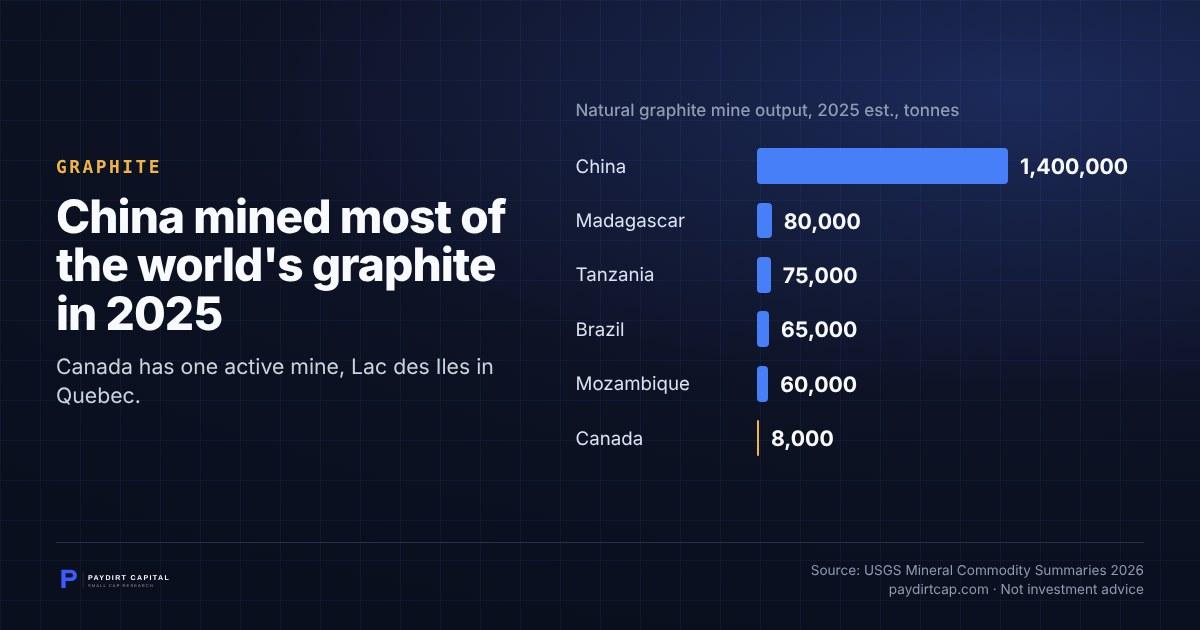
- Graphite is the largest component of a lithium-ion battery by weight, and China mined about 1.4 million of the world's 1.8 million tonnes in 2025.
- Canada was the world's fourth-largest nickel producer in 2024 at 125,364 tonnes, while Indonesia produced about 67% of 2025 mine output.
- BloombergNEF ranked Canada second, tied with the US, in May 2025, citing slow progress on scaling battery manufacturing.
A lithium-ion battery needs more than lithium. The anode is mostly graphite, and many cathodes are built on nickel. Canada mines nickel at scale and holds graphite reserves, but most of the processing between the mine and the battery cell still happens elsewhere, mainly in China for graphite and Indonesia for nickel.
What goes into a battery cell
A lithium-ion cell has two electrodes. The cathode holds the lithium and, in many chemistries, nickel, manganese and cobalt. The anode is where lithium ions sit when the battery is charged, and it is usually made of graphite. Natural Resources Canada describes graphite as the single largest component in a typical lithium-ion battery by weight.
Both materials need processing before they reach a cell:
- Graphite is mined as flake, then shaped and purified into spherical purified graphite before it becomes anode material. Synthetic graphite, which is manufactured rather than mined, competes for the same use. NRCan says synthetic graphite makes up about 70% of total graphite use.
- Nickel for batteries is usually turned into nickel sulphate, which Benchmark Mineral Intelligence calls the chemical link between mining and cell manufacturing.
Batteries took about 15% of global nickel consumption in 2024, according to NRCan. Stainless steel is still the largest use at nearly two-thirds. Benchmark projects battery nickel demand to reach about 1.5 million tonnes by 2035, or 27% of total consumption.
Graphite: China mines most, and processes more
USGS estimates for natural graphite, published February 2026, in tonnes:
| Country | 2024 | 2025 (est.) | Reserves |
|---|---|---|---|
| China | 1,270,000 | 1,400,000 | 100,000,000 |
| Madagascar | 85,000 | 80,000 | 27,000,000 |
| Tanzania | 27,000 | 75,000 | 18,000,000 |
| Brazil | 58,000 | 65,000 | 74,000,000 |
| Mozambique | 39,000 | 60,000 | 25,000,000 |
| Canada | 11,700 | 8,000 | 5,900,000 |
| World total (rounded) | 1,550,000 | 1,800,000 | 310,000,000 |
Canada has one active graphite mine, Lac des Iles in Quebec, which produced 11,697 tonnes in 2024, according to NRCan. That put Canada eighth in the world at about 0.7% of output.
The processing step is where the market is tightest. In the first nine months of 2025 China exported 37,400 tonnes of spherical purified graphite, up 29% year over year, with South Korea, Indonesia, Japan and the United States the main buyers, per the USGS. In October 2025 China announced export controls on battery supply chain materials including graphite anode materials, and the IEA estimated that a full disruption would put more than US$300 billion a year of downstream production outside China at risk. In the United States, the Commerce Department's preliminary 2025 results set antidumping duties of 93.5% on Chinese active anode material.
Nickel: Canada produces, Indonesia dominates
Nickel ore comes in two main types. Sulphide ores, found mainly in Canada, Russia and Australia, grade roughly 0.5% to 3% nickel and are easier to process into high-purity metal. Laterite ores, found in Indonesia, the Philippines and New Caledonia, grade about 1% to 2% and need energy-intensive processing, per Benchmark.
Canada produced 125,364 tonnes of nickel in concentrate in 2024, fourth in the world, according to NRCan. Ontario supplied 39.9%, Quebec 37.1%, Newfoundland and Labrador 13.7% and Manitoba 9.3%. Canada has refineries in Fort Saskatchewan, Alberta; Sudbury, Ontario; and Long Harbour, Newfoundland and Labrador. Nickel exports were worth $4.5 billion in 2024. Canada supplied 44% of US primary nickel imports from 2021 to 2024, per the USGS.
Indonesia changed the market. After a 2020 ore export ban, it built processing capacity at home and now accounts for about 60% of refined nickel output, according to Benchmark. The USGS puts Indonesia's 2025 mine output at 2.6 million tonnes out of a world total of 3.9 million.
The result was oversupply. The International Nickel Study Group, cited by the USGS, estimated a surplus of 98,500 tonnes in 2022, 170,000 in 2023 and 182,000 in 2024. The LME cash price averaged $25,815 per tonne in 2022 and an estimated $15,000 in 2025. Australian mine output fell an estimated 54% in 2025 as several mines were placed on care and maintenance.
By the numbers: Canada's share
| Measure | Canada | World | Canada's share |
|---|---|---|---|
| Nickel mine output, 2025 (USGS est.) | 140,000 t | 3,900,000 t | About 3.6% |
| Nickel reserves (USGS) | 2,200,000 t | Over 140,000,000 t | About 1.6% or less |
| Graphite mine output, 2025 (USGS est.) | 8,000 t | 1,800,000 t | About 0.4% |
| Graphite reserves (USGS) | 5,900,000 t | 310,000,000 t | About 1.9% |
The calculation for nickel output: 140,000 divided by 3,900,000 is about 3.6%. Indonesia's share on the same basis is 2,600,000 divided by 3,900,000, about 67%. Canada is a meaningful sulphide nickel producer in a market set by Indonesian laterite volume.
Where Canada sits in the chain
BloombergNEF ranks 30 countries each year on their potential to build a secure battery supply chain. Canada placed second in November 2022, took first place in early 2024, and was second, tied with the United States, behind China in May 2025. BNEF called Canada a raw materials powerhouse with a stable investment environment, but said slower progress on scaling battery manufacturing weakened its advantage, noting paused investments by E-One Moli, Ford and Umicore.
The pattern is consistent: Canada mines, while the processing steps with the most value added, such as spherical graphite, nickel sulphate, cathode and anode material, are mostly done abroad. For the policy response, see Canada's critical minerals strategy, and for the trade backdrop, Canada and US trade in 2026.
What to watch
- The USGS Mineral Commodity Summaries 2027, expected early in 2027.
- NRCan's annual graphite and nickel facts updates.
- International Nickel Study Group market balance reports.
- Any change to China's October 2025 export controls on graphite anode materials.
- BloombergNEF's next battery supply chain ranking.
Sources
- USGS Mineral Commodity Summaries 2026: Graphite (Natural)
- USGS Mineral Commodity Summaries 2026: Nickel
- Natural Resources Canada: Graphite facts
- Natural Resources Canada: Nickel facts
- Benchmark Mineral Intelligence: What is nickel?
- IEA: Global Critical Minerals Outlook 2026, Executive Summary
- BloombergNEF, May 13, 2025: China Regains Number One Spot in Global Lithium-Ion Battery Supply Chain Ranking
- Electric Autonomy, February 5, 2024: Canada grabs top spot in BloombergNEF world battery ranking
- BloombergNEF, November 12, 2022: China's Battery Supply Chain Tops BNEF Ranking, Canada a Close Second
Frequently asked questions
Does Canada produce graphite?
Yes, on a small scale. Canada has one active graphite mine, Lac des Iles in Quebec, which produced 11,697 tonnes of natural graphite in 2024, according to Natural Resources Canada. That ranked Canada eighth globally at about 0.7% of output. The USGS estimates Canadian graphite reserves at 5.9 million tonnes, out of about 310 million tonnes worldwide.
How much nickel does Canada produce?
Canada produced 125,364 tonnes of nickel in concentrate in 2024, ranking fourth in the world, according to Natural Resources Canada. Ontario and Quebec supplied most of it, with Newfoundland and Labrador and Manitoba making up the rest. Canada has refineries in Fort Saskatchewan, Sudbury and Long Harbour, and nickel exports were worth $4.5 billion in 2024.
Why does Indonesia dominate nickel supply?
Indonesia banned nickel ore exports in 2020 and built processing capacity at home to turn laterite ore into steel feedstock and battery materials. Benchmark Mineral Intelligence says it now accounts for about 60% of refined nickel output. The USGS estimates Indonesia mined 2.6 million tonnes of nickel in 2025, out of a world total of 3.9 million.
Related reading
Disclaimer
This content is published by Paydirt Capital, a brand of Apollo Shareholder Relations, for informational purposes only. It is not investment advice, a recommendation, or an offer or solicitation to buy or sell any security. Nothing here should be relied on for investment decisions. Readers should conduct their own due diligence and consult a registered investment advisor before making any investment.
Apollo Shareholder Relations provides paid investor relations, marketing, and communications services to publicly traded companies and may be compensated in cash or securities by companies in the sectors discussed. Where a company mentioned in this content is or becomes a client, Apollo may hold a financial interest in that company and its securities. This content is not independent research.
All facts and figures are drawn from public sources believed to be reliable, but accuracy is not guaranteed. Any forward-looking statements reflect current expectations only and actual outcomes may differ materially. Paydirt Capital and Apollo Shareholder Relations accept no liability for any loss arising from the use of this content.
The Weekly Dig
Find more good dirt in your inbox. The latest stories and ideas, free to subscribe.
Free to subscribe. Unsubscribe anytime. Sponsored content is disclosed.