Shells and Reverse Takeovers on Canada's Venture Markets: How an RTO Works
Capital pool companies, NEX shells and the reverse takeover process on TSX Venture and the CSE: definitions, halts, approvals, escrow and 2026 deal counts.
Key takeaways
- TSX Venture defines a reverse takeover as a deal leaving new shareholders with over 50% of votes and a change of control.
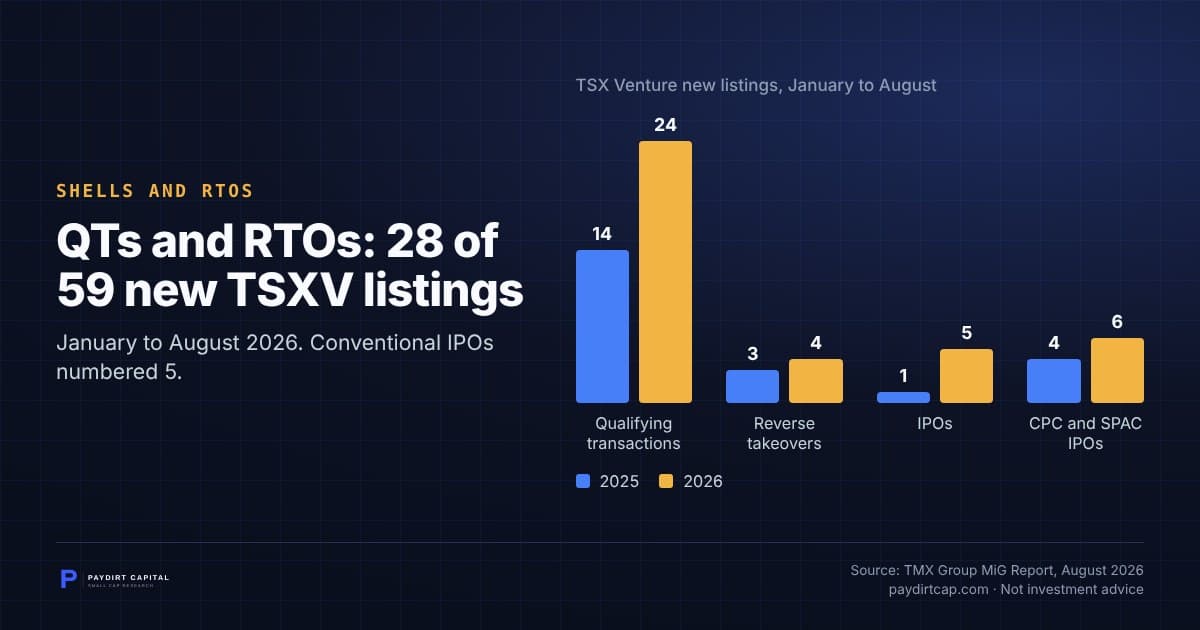
- Qualifying transactions and RTOs made up 28 of 59 new TSX Venture listings from January to August 2026.
- Trading halts on announcement of an RTO or CSE fundamental change, and principals' shares go into escrow after completion.
A reverse takeover lets a private company become public by merging into an existing listed company, usually a shell with little or no business. The private company's owners end up with most of the shares, and the listed company takes on the new business. On TSX Venture and the CSE this route follows a set process: a trading halt, disclosure close to prospectus level, often a shareholder vote, and escrow for the new insiders.
What counts as a shell
On the Canadian venture markets, shells come in three common forms:
- Capital pool companies (CPCs): TSX Venture's purpose-built shells. A CPC raises between $200,000 and $9,500,000 in its IPO, with total gross proceeds from all share issuances capped at $10,000,000, and then looks for a business to acquire. As at August 31, 2026, 153 CPCs were listed on TSX Venture, with a combined market capitalization of about $96 million.
- CPC conduct rule: until its qualifying transaction is complete, a CPC may not engage anyone to provide investor relations, promotional or market-making services.
- NEX issuers: former TSX Venture or TSX companies that no longer meet Tier 2 continued listing requirements and trade on the NEX board.
- Inactive listed companies: issuers whose original business has wound down but that keep their listing and reporting status.
The CPC program dates to 1986. TMX Group states that, as at December 31, 2024, more than 2,800 CPCs had been created and 85% of CPCs had completed a qualifying transaction. Since January 1, 2021, a CPC no longer faces suspension, delisting or transfer to NEX for failing to complete a qualifying transaction within 24 months, according to a Cassels summary of the rule changes.
What makes a deal a reverse takeover
TSX Venture Policy 5.2 defines a reverse takeover (RTO) as an acquisition by or of the issuer, plus a share issuance, that results in both:
- new shareholders holding more than 50% of the issuer's outstanding voting securities; and
- a change of control of the issuer.
Shares from a linked private placement can count toward both tests. Policy 5.2 also covers a change of business, a transaction that redirects an issuer's resources and changes the nature of its business, and it follows much the same process. When a CPC acquires its first business, the deal is called a qualifying transaction. The CSE uses the term "fundamental change." Its Policy 8 describes a fundamental change as one that effectively results in a new listed issuer, such that the existing disclosure record cannot be relied on to value the company's securities.
How an RTO works, step by step
- Agreement and halt. On TSX Venture, once the parties reach an RTO agreement, the issuer must notify the exchange and the regulation services provider, and trading is halted immediately. On the CSE, trading is halted on announcement of a fundamental change, and during the halt no dealer may quote or trade the security in any marketplace or over the counter.
- News release and resumption. A TSX Venture issuer stays halted until a comprehensive news release is out, insiders' shares are pooled until final acceptance, personal information forms are filed for incoming directors and officers, and the exchange completes background checks and a preliminary review.
- Concurrent financing. Most deals include one. Under TSX Venture Policy 5.4, one way to show an acceptable capital structure is a financing with mostly arm's length buyers that equals at least 10% of the post-deal shares or raises at least $5,000,000.
- Disclosure document. TSX Venture requires an information circular for a shareholder meeting, or a filing statement where approval is by written consent or not needed. The CSE requires full, true and plain disclosure about the resulting company, including target financial statements as if it were going public by prospectus, plus pro forma statements.
- Shareholder approval. TSX Venture requires prior shareholder approval unless all of a list of conditions is met, such as the deal not being a related party transaction and the issuer being without active operations, for example a NEX issuer. The CSE requires exchange and securityholder approval before completion.
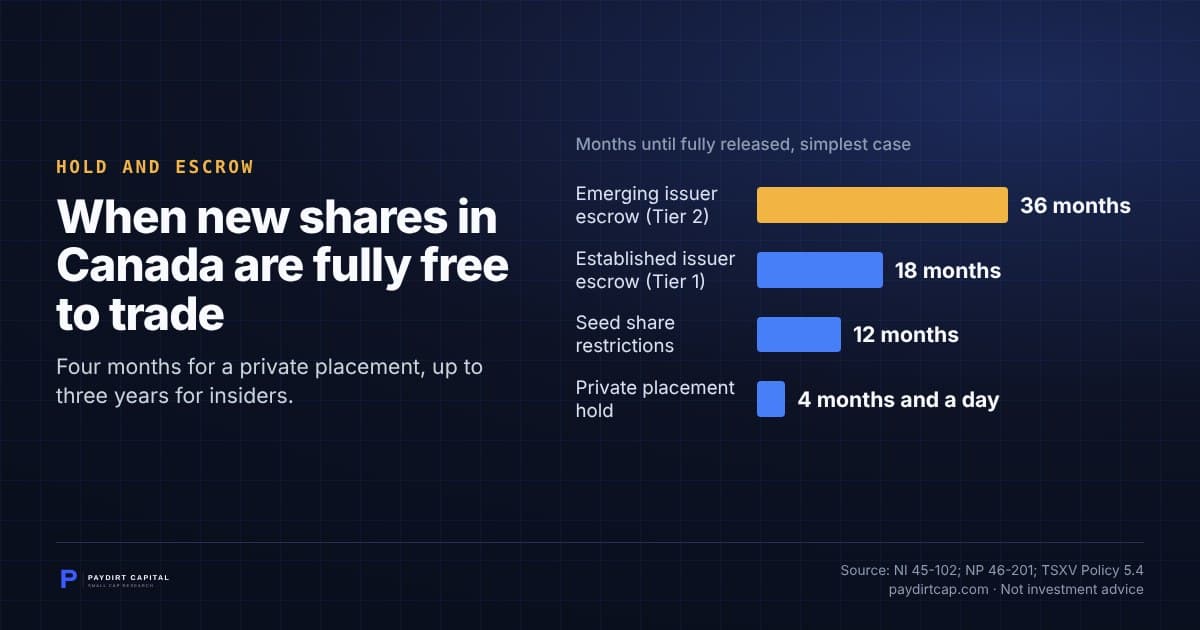
- Listing standards and escrow. The resulting issuer must meet initial listing requirements. Principals' shares go into escrow under Policy 5.4, and non-principal seed shares face resale restrictions.
- Final bulletin. The exchange issues a final bulletin after closing, and the company trades under its new name and business.
By the numbers
From TMX Group's MiG report for the first eight months of 2026, against the same period of 2025:
| TSX Venture new listings, January to August | 2026 | 2025 |
|---|---|---|
| Total new listings | 59 | 41 |
| Qualifying transactions (CPCs) | 24 | 14 |
| Reverse takeovers | 4 | 3 |
| IPOs (excluding CPCs, ETFs, closed-end funds and SPACs) | 5 | 1 |
| CPC and SPAC IPOs | 6 | 4 |
Qualifying transactions and RTOs together made up 28 of 59 new TSX Venture listings in 2026 to August, or about 47%. Conventional IPOs were 5. On the CSE, the exchange reported nine new company listings and three fundamental changes in August 2026 alone.
A hypothetical share count shows why the new owners control the result. A shell has 20,000,000 shares. It issues 80,000,000 shares to the private company's owners and 12,000,000 in a concurrent financing, for 112,000,000 in total.
- Private company owners: 80,000,000 / 112,000,000 = 71.4%, above the 50% RTO threshold.
- Financing buyers: 12,000,000 / 112,000,000 = 10.7%, above the 10% capital structure test.
- Original shell holders: 20,000,000 / 112,000,000 = 17.9%.
Mergers between producing companies work differently. For that side of the market, see our review of gold miner M&A in 2026.
What to watch
- Trading halt notices and the comprehensive news release that follows.
- The filing statement, information circular or CSE listing statement on SEDAR+, including target financials.
- Shareholder meeting dates and written consent disclosures.
- Exchange bulletins for conditional acceptance and final acceptance.
- Escrow release dates for the new principals, which start from the final bulletin date.
Sources
- TSX Venture Exchange Corporate Finance Manual (Policies 2.4, 5.2, 5.4)
- TMX Group MiG Report, August 2026
- TSX: The Capital Pool Company Program
- TSX Venture Exchange Announces Changes to Capital Pool Company Program (December 1, 2020)
- Cassels: Changes to the TSXV's Capital Pool Company Program and Policy 2.4
- CSE Policy 8: Fundamental Changes and Changes of Business, as of May 22, 2025
- Canadian Securities Exchange Reports August 2026 Performance Figures
Frequently asked questions
What is a reverse takeover on the TSX Venture Exchange?
Under TSX Venture Policy 5.2, a reverse takeover is an acquisition by or of a listed issuer, plus a share issuance, that leaves new shareholders with more than 50% of the voting securities and results in a change of control. Shares from a linked private placement can count toward both tests.
What is a capital pool company?
A capital pool company is a TSX Venture shell created to find and buy a business. It raises between $200,000 and $9,500,000 in its IPO, with total proceeds capped at $10,000,000. Its acquisition is called a qualifying transaction. TMX Group says more than 2,800 CPCs were created from 1986 to the end of 2024.
Does a reverse takeover need shareholder approval?
On TSX Venture, prior shareholder approval is required unless every condition in Policy 5.2 is met, including that the deal is not a related party transaction and the issuer is without active operations. On the CSE, a fundamental change must be approved by the exchange and securityholders before it is completed.
Related reading
Disclaimer
This content is published by Paydirt Capital, a brand of Apollo Shareholder Relations, for informational purposes only. It is not investment advice, a recommendation, or an offer or solicitation to buy or sell any security. Nothing here should be relied on for investment decisions. Readers should conduct their own due diligence and consult a registered investment advisor before making any investment.
Apollo Shareholder Relations provides paid investor relations, marketing, and communications services to publicly traded companies and may be compensated in cash or securities by companies in the sectors discussed. Where a company mentioned in this content is or becomes a client, Apollo may hold a financial interest in that company and its securities. This content is not independent research.
All facts and figures are drawn from public sources believed to be reliable, but accuracy is not guaranteed. Any forward-looking statements reflect current expectations only and actual outcomes may differ materially. Paydirt Capital and Apollo Shareholder Relations accept no liability for any loss arising from the use of this content.
The Weekly Dig
Find more good dirt in your inbox. The latest stories and ideas, free to subscribe.
Free to subscribe. Unsubscribe anytime. Sponsored content is disclosed.