How Mining Taxes and Royalties Work in Canada: Federal and Provincial
How Canadian mines are taxed: the 15% federal rate, mining-specific deductions, and how the BC, Ontario and Quebec mining taxes are built, with a worked example.
Key takeaways
- Canadian mines pay federal corporate tax at 15%, provincial corporate tax, and a separate provincial mining tax that is deductible federally.
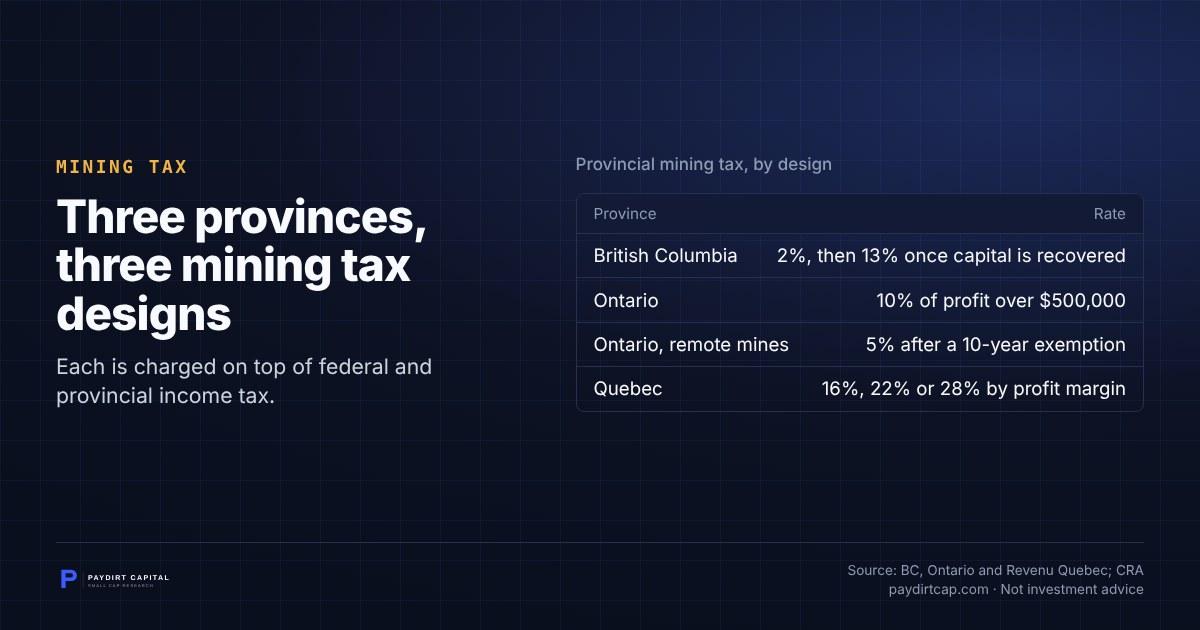
- BC charges 2% then 13% as capital is recovered; Ontario 10% of profit over $500,000; Quebec 16% to 28% by profit margin.
- Mining paid $6.8 billion in corporate income taxes and royalties in 2023, 58% of it as mining taxes and royalties.
A Canadian mine pays three layers of tax on its profits: federal corporate income tax, provincial corporate income tax, and a separate provincial mining tax or royalty. The federal rate is uniform. The mining taxes are not, and they differ widely in design from one province to the next. Most are levied on profit rather than on revenue, which shapes how much a mine pays in good years and bad.
The federal layer
Ottawa does not levy a mining royalty. It taxes mining companies like other corporations, at a general federal rate of 15% after the general tax reduction, according to the Canada Revenue Agency. Several mining-specific rules sit inside that system, as set out by Natural Resources Canada:
- Canadian exploration expenses (CEE) are 100% deductible in the year incurred, and unused balances carry forward indefinitely.
- Canadian development expenses (CDE) are deducted at 30% a year on a declining balance.
- Flow-through shares let exploration companies pass CEE deductions to investors. The 15% Mineral Exploration Tax Credit and the 30% Critical Mineral Exploration Tax Credit add to those deductions. We explain the mechanics in flow-through shares explained.
- Provincial mining taxes and royalties paid on mineral resource income are fully deductible when calculating income for federal tax.
- Accelerated capital cost allowances for mining were phased out between 2017 and 2020.
NRCan lists the Mineral Exploration Tax Credit as extended to March 31, 2027. The Critical Mineral Exploration Tax Credit applies to flow-through agreements entered into after April 7, 2022 and up to March 31, 2027, and covers 15 designated critical minerals.
The provincial layer: income tax plus a mining tax
Provinces charge their own corporate income tax on top of the federal rate. The CRA lists general (higher) rates of 12% in British Columbia and Saskatchewan and 11.5% in Ontario. Quebec and Alberta collect their own corporate taxes separately.
The mining tax is a second, separate provincial charge for the minerals the province owns. British Columbia, Ontario and Quebec use three different designs.
| Province | Tax | Base | Rates |
|---|---|---|---|
| British Columbia | Mineral tax | Net current proceeds, then net revenue | 2% while capital is being recovered; 13% after |
| Ontario | Mining tax | Profit over $500,000 | 10%; 5% for remote mines |
| Quebec | Mining tax | Annual profit, by profit margin | 16%, 22% or 28%; minimum tax of 1% and 4% of mine-mouth output value |
British Columbia: two taxes in sequence
BC's mineral tax tracks unrecovered capital in a Cumulative Expenditure Account (CEA). It includes pre-production costs, equipment, exploration and reclamation. It excludes financing costs, hedging losses and compensation above $75,000 paid to significant shareholders. While the CEA has a balance, the mine pays a 2% net current proceeds tax, roughly revenue minus current operating costs. Once capital is recovered, the rate becomes a 13% net revenue tax. Operators can use a cumulative credit for the 2% tax already paid to reduce the 13% tax, so the same income is not taxed twice.
Ontario: a flat rate on profit with holidays
Ontario charges 10% of an operator's profit above $500,000, a threshold associated corporations must share. New mines and major expansions get a tax holiday of three years or $10 million of profit, whichever comes first. Remote mines get a 10-year exemption, after which they pay 5%.
Quebec: rates that rise with the margin
Quebec's rate depends on the operator's profit margin, defined as annual profit divided by the gross value of annual output from all its mines. Revenu Québec sets three brackets: 16% for a margin from 0% to 35%, 22% for more than 35% and up to 50%, and 28% for more than 50%. Quebec also has a minimum mining tax: 1% of mine-mouth output value up to $80 million and 4% above that. Two allowances reduce the output value for this purpose: a depreciation allowance and a processing allowance. The minimum tax keeps some tax flowing from a mine even in a year with thin profits.
The math: an Ontario example
Take an Ontario operator, not in a tax holiday or remote, with $100 million of profit as defined for mining tax. Using the published rules:
- Profit above the exemption: $100 million minus $500,000 = $99.5 million.
- Ontario mining tax at 10%: $9.95 million.
- Because the mining tax is fully deductible for federal income tax, it lowers federal taxable income by $9.95 million. At the 15% federal rate, that cuts federal tax by about $1.49 million ($9.95 million x 0.15).
So the mining tax costs this operator about $8.46 million net of the federal deduction, before provincial income tax effects. The example is simplified. Taxable profit for mining tax and for income tax are calculated under different rules, and the numbers will not match line for line in a real return.
How much it adds up to
Natural Resources Canada reports that mining paid $6.8 billion in corporate income taxes and royalties in 2023, with 58% of it coming from mining taxes and royalties. That is about $3.9 billion ($6.8 billion x 0.58) from the provincial layer alone.
Government royalties are separate from private royalties. A company can also owe a net smelter return or stream to a royalty company under a private contract. That is a commercial deal, not a tax. See how royalty and streaming companies make money.
What to watch
- Federal and provincial budgets, which set changes to mining tax rates, credits and holidays.
- Expiry and extension dates for the Mineral Exploration Tax Credit and the Critical Mineral Exploration Tax Credit.
- Mining tax and royalty lines in producers' financial statements, which show what each mine actually paid.
- NRCan's annual update on tax and royalty payments from the minerals sector.
Sources
- Natural Resources Canada: Mining-specific tax provisions
- Canada Revenue Agency: Corporation tax rates
- Province of British Columbia: Mineral tax for coal and other mines
- Ontario Ministry of Finance: Mining tax rates
- Revenu Québec: Rates of the mining tax on annual profit
- Revenu Québec: Calculating the minimum mining tax
- Natural Resources Canada: Minerals economy
Frequently asked questions
What is the mining tax rate in Ontario?
Ontario's mining tax is 10% of an operator's profit above $500,000, a threshold associated corporations must share. New mines and major expansions get a tax holiday of three years or $10 million of profit, whichever comes first. Remote mines get a 10-year exemption and then pay a reduced rate of 5%.
How does the BC mineral tax work?
British Columbia's mineral tax runs in two stages. While a mine still has unrecovered capital in its Cumulative Expenditure Account, it pays a 2% net current proceeds tax. Once capital is recovered, it pays a 13% net revenue tax, reduced by a cumulative credit for the 2% tax already paid so the same income is not taxed twice.
Are provincial mining taxes deductible for federal income tax?
Yes. Natural Resources Canada states that mining taxes and royalties paid to a province or territory on mineral resource income are fully deductible when calculating income for federal tax. In an Ontario example with $100 million of profit, the $9.95 million mining tax lowers federal tax by about $1.49 million at the 15% federal rate.
Related reading
Disclaimer
This content is published by Paydirt Capital, a brand of Apollo Shareholder Relations, for informational purposes only. It is not investment advice, a recommendation, or an offer or solicitation to buy or sell any security. Nothing here should be relied on for investment decisions. Readers should conduct their own due diligence and consult a registered investment advisor before making any investment.
Apollo Shareholder Relations provides paid investor relations, marketing, and communications services to publicly traded companies and may be compensated in cash or securities by companies in the sectors discussed. Where a company mentioned in this content is or becomes a client, Apollo may hold a financial interest in that company and its securities. This content is not independent research.
All facts and figures are drawn from public sources believed to be reliable, but accuracy is not guaranteed. Any forward-looking statements reflect current expectations only and actual outcomes may differ materially. Paydirt Capital and Apollo Shareholder Relations accept no liability for any loss arising from the use of this content.
The Weekly Dig
Find more good dirt in your inbox. The latest stories and ideas, free to subscribe.
Free to subscribe. Unsubscribe anytime. Sponsored content is disclosed.