Canada's Mining Regions Explained: Abitibi to the Athabasca Basin
A plain guide to five Canadian mining regions: the Abitibi, Timmins, Red Lake, the Golden Triangle and the Athabasca Basin, with dated production facts.
Key takeaways
- The Abitibi gold belt, from Wawa to Val-d'Or, has produced over 100 mines and 170 million ounces of gold since 1901.
- Timmins and Porcupine camps produced 73.3 million ounces of gold from inception to the end of 2016.
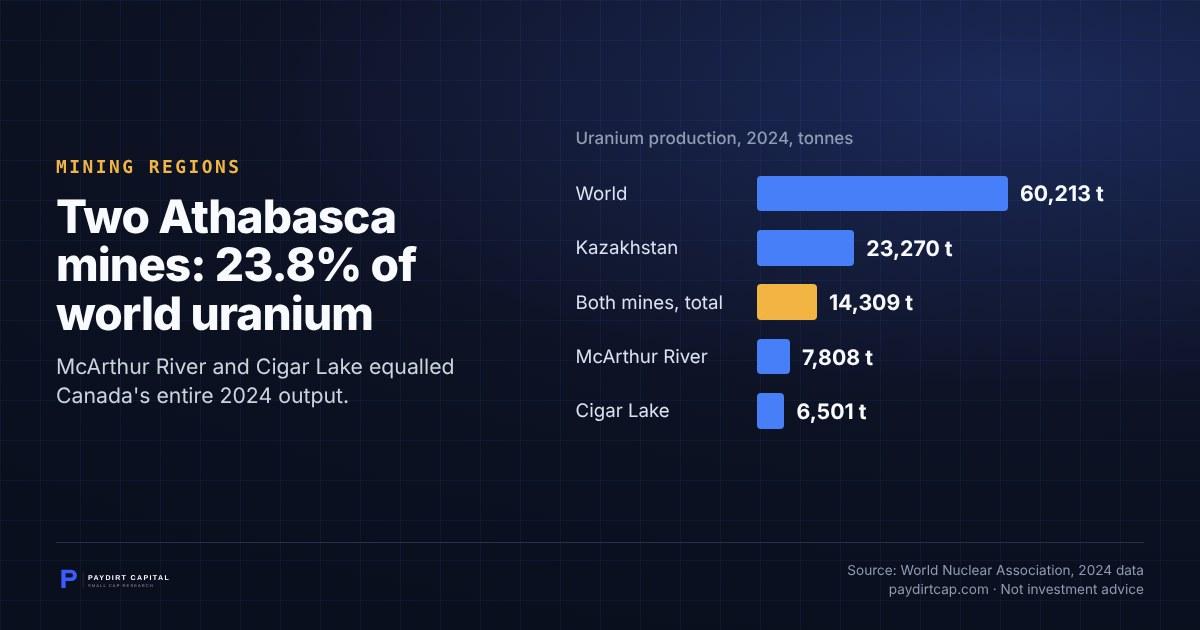
- Two Athabasca Basin mines produced 14,309 tonnes of uranium in 2024, about 23.8% of world output.
Five place names come up again and again in Canadian mining news: the Abitibi, Timmins, Red Lake, the Golden Triangle and the Athabasca Basin. Four are gold districts with long production records. The fifth hosts two uranium mines that together produced about 24% of the world's uranium in 2024.
The five regions at a glance
| Region | Province | Main commodity | Dated production fact |
|---|---|---|---|
| Abitibi gold belt | Ontario and Quebec | Gold | Over 100 mines and 170 million ounces of gold since 1901 |
| Timmins (Porcupine camp) | Ontario | Gold | 73.3 million ounces from inception to the end of 2016 |
| Red Lake | Ontario | Gold | More than 25 million ounces from the Red Lake complex since 1949, as of November 2019 |
| Golden Triangle | British Columbia | Copper and gold | Red Chris block cave approvals granted June 2026 |
| Athabasca Basin | Saskatchewan | Uranium | 14,309 tonnes of uranium from two mines in 2024 |
The Abitibi: Canada's largest gold belt
The Abitibi gold belt runs from Wawa, Ontario, east to Val-d'Or, Quebec. It has produced over 100 mines and 170 million ounces of gold since 1901.
Several of the country's best-known mining towns sit on it. Kirkland Lake earned the nickname "the mile of gold" and still has active mining. Val-d'Or means "valley of gold." Virginiatown is home to the Kerr Addison mine, once Canada's largest gold-producing mine. At Malartic, Quebec, a large open-pit operation began commercial production in June 2011. Timmins, the largest camp in the belt, gets its own section below.
Timmins: the Porcupine camp
Timmins was founded in 1912, after the Porcupine Gold Rush. The camp's early mines, Hollinger, McIntyre and Dome, built the town. According to the Ontario Ministry of Northern Development and Mines, as reported by MINING.COM in 2017, the Timmins and Porcupine camps produced 73.3 million ounces of gold from inception to the end of 2016.
Dome was discovered in 1909 and closed on December 31, 2017, after 107 years of operation. Ownership in the camp has since changed hands. On April 16, 2025, Newmont said it had completed the sale of its Porcupine operation in Ontario, taking shares in the buyer as part of the consideration.
Red Lake: northwestern Ontario
Red Lake sits in northwestern Ontario, far to the west of the Abitibi belt. Global News reported in November 2019 that the Red Lake complex had produced more than 25 million ounces of gold since production started in 1949, and 276,000 ounces in 2018.
That month, Australia's Evolution Mining agreed to buy the complex from Newmont for US$375 million. Newmont was also to receive US$20 million for each million ounces of new gold resources discovered, capped at five million ounces over 15 years.
The Golden Triangle: copper and gold in northwest B.C.
The Golden Triangle is an informal name for a mineral-rich area in northwestern British Columbia. It produces copper as well as gold, and its best-known current operation shows how mines there are changing.
The largest current operation is Red Chris, a copper-gold mine that Newmont operates as majority owner with a 30% joint venture partner. On June 19, 2026, Newmont said British Columbia had granted an amended environmental assessment certificate, reached through a consent-based process with the Tahltan Nation, plus an amended Mines Act permit for a shift from open pit to underground block caving. Newmont said the project would extend mine life into the mid-2040s and expects it to raise Canada's copper production by roughly 15%. It said a final investment decision was targeted for later in 2026.
The Athabasca Basin: the world's richest uranium ore
The Athabasca Basin in northern Saskatchewan is the reason Canada is a uranium power. The World Nuclear Association reports average ore grades of 9.60% U3O8 at McArthur River and 15.9% at Cigar Lake, far above the global average.
Cameco calls McArthur River and the Key Lake mill the world's largest high-grade uranium mine and mill. McArthur River has operated since 1999 and Key Lake since 1983. Ore is mined 530 to 640 metres below surface, then trucked 80 kilometres south to Key Lake as slurry. Cameco's 2026 production guidance for McArthur River is 14.0 million to 16.5 million pounds of U3O8 on a 100% basis. For more on demand for this fuel, see our piece on AI data centres and uranium.
By the numbers
World Nuclear Association data for 2024:
- McArthur River and Key Lake: 7,808 tonnes of uranium, 13% of world production.
- Cigar Lake: 6,501 tonnes, 11% of world production.
- Canada: 14,309 tonnes. World: 60,213 tonnes.
Add the two mines: 7,808 + 6,501 = 14,309 tonnes. That equals Canada's entire reported 2024 output. Divide by world output: 14,309 / 60,213 = 23.8%. Two underground mines in one Saskatchewan basin supplied nearly a quarter of the world's uranium, second only to Kazakhstan's 23,270 tonnes as a country.
Grade makes the same point. At 15.9% U3O8, a tonne of Cigar Lake ore holds about 159 kilograms of U3O8. At McArthur River's 9.60%, the figure is about 96 kilograms. Grade on that scale is what lets two mines carry a national industry.
What to watch
- Red Chris: Newmont's final investment decision on the block cave, targeted for later in 2026.
- Cameco quarterly reports: McArthur River output against 2026 guidance of 14.0 million to 16.5 million pounds.
- World Nuclear Association: its annual update of world uranium production by country and mine.
- Ontario and Quebec gold camps: ownership changes in these camps show up in company news releases and filings, such as Newmont's 2025 Porcupine sale. Our review of gold miner M&A in 2026 tracks the larger deals.
Sources
- Wikipedia: Abitibi gold belt
- MINING.COM: Goldcorp closing 107-year-old Dome mine (August 2017)
- Newmont: Completes non-core divestiture program with sale of Akyem and Porcupine (April 16, 2025)
- Global News: Evolution Mining buys Red Lake gold complex for US$375M (November 2019)
- Newmont: Red Chris Block Cave Project receives major regulatory approvals (June 19, 2026)
- World Nuclear Association: World uranium mining production
- World Nuclear Association: Uranium in Canada
- Cameco: McArthur River and Key Lake
Frequently asked questions
Where is the Abitibi gold belt?
The Abitibi gold belt runs from Wawa, Ontario, east to Val-d'Or, Quebec. It has produced over 100 mines and 170 million ounces of gold since 1901. Mining towns on the belt include Timmins, Kirkland Lake, known as the mile of gold, Val-d'Or, Malartic and Virginiatown, home of the Kerr Addison mine.
Why is the Athabasca Basin important for uranium?
The Athabasca Basin in northern Saskatchewan hosts McArthur River and Cigar Lake, with average ore grades of 9.60% and 15.9% U3O8. In 2024 the two mines produced 14,309 tonnes of uranium, equal to Canada's entire reported output and about 23.8% of the world's 60,213 tonnes.
What is the Golden Triangle in British Columbia?
The Golden Triangle is an informal name for a mineral-rich area of northwestern British Columbia that produces copper and gold. Its largest current operation is Red Chris, operated by Newmont, which received June 2026 approvals to move from open pit to underground block caving, extending mine life into the mid-2040s.
Related reading
Disclaimer
This content is published by Paydirt Capital, a brand of Apollo Shareholder Relations, for informational purposes only. It is not investment advice, a recommendation, or an offer or solicitation to buy or sell any security. Nothing here should be relied on for investment decisions. Readers should conduct their own due diligence and consult a registered investment advisor before making any investment.
Apollo Shareholder Relations provides paid investor relations, marketing, and communications services to publicly traded companies and may be compensated in cash or securities by companies in the sectors discussed. Where a company mentioned in this content is or becomes a client, Apollo may hold a financial interest in that company and its securities. This content is not independent research.
All facts and figures are drawn from public sources believed to be reliable, but accuracy is not guaranteed. Any forward-looking statements reflect current expectations only and actual outcomes may differ materially. Paydirt Capital and Apollo Shareholder Relations accept no liability for any loss arising from the use of this content.
The Weekly Dig
Find more good dirt in your inbox. The latest stories and ideas, free to subscribe.
Free to subscribe. Unsubscribe anytime. Sponsored content is disclosed.