How to Read SEDI Insider Trading Filings in Canada
SEDI is where Canadian insiders report their trades. Here is who files, the deadlines, what the transaction codes mean and how to read a filing line by line.
Key takeaways
- Canadian reporting insiders generally must file a SEDI report within five calendar days of any change in their holdings.
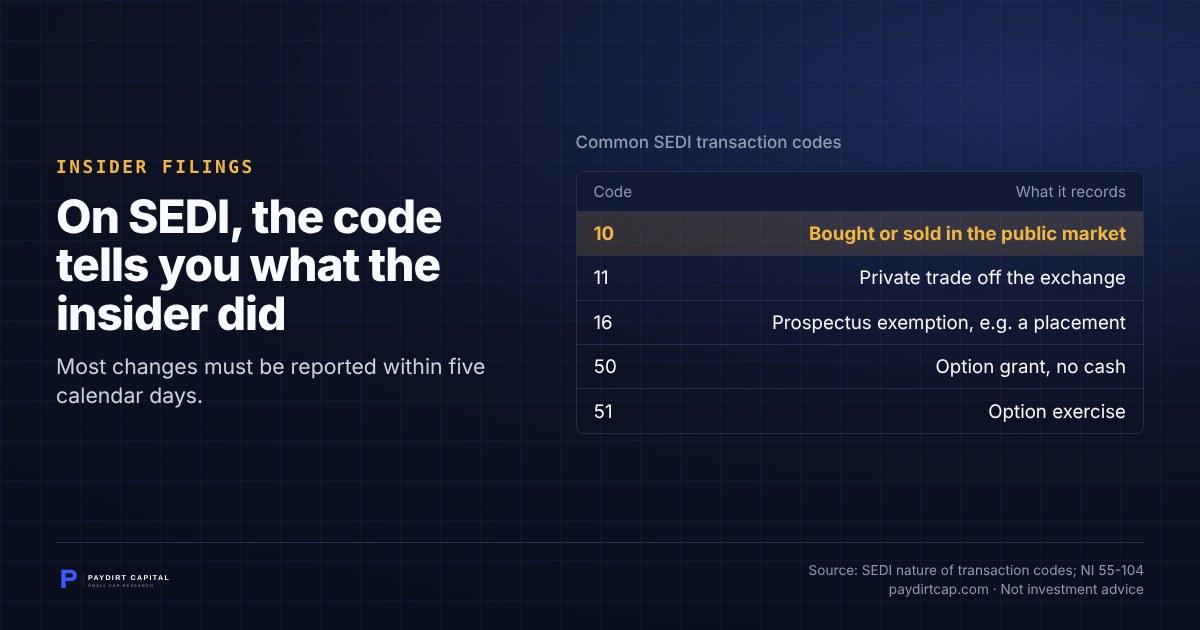
- Code 10 means a public market trade, code 16 a prospectus-exempt deal such as a private placement, and code 50 an option grant.
- Judge an insider trade by its size against the insider's total holdings across all direct and indirect accounts.
SEDI is the national database where insiders of Canadian public companies report their trades. Directors, senior officers and holders of more than 10% of the voting rights generally must report a change in their holdings within five calendar days. Reading those reports well comes down to two things: the transaction code, and the size of the trade against what the insider already owns.
What SEDI is and who has to file
SEDI stands for System for Electronic Disclosure by Insiders. The Canadian Securities Administrators describe it as Canada's online service for filing and viewing insider trading reports. It replaced paper filings, and anyone can search it for free.
The reporting rules sit in National Instrument 55-104. Under that instrument, a "reporting insider" includes:
- The CEO, CFO and COO of the issuer, and of a significant shareholder or major subsidiary
- Directors of those same entities
- People responsible for a principal business unit or division
- Significant shareholders, meaning anyone with more than 10% of the voting rights
- Management companies that provide significant services, and their directors and officers
- Any other insider with routine access to material undisclosed information and significant influence over the issuer
The deadlines
| Event | Filing deadline | Rule |
|---|---|---|
| Becoming a reporting insider | 10 calendar days | NI 55-104, s. 3.2 |
| Any change in holdings | 5 calendar days | NI 55-104, s. 3.3 |
| Stock-based compensation, if the issuer files an issuer grant report | Deferral to March 31 of the next year allowed | NI 55-104, s. 6.4 |
| Shares bought under an automatic securities purchase plan | Deferral to March 31 of the next year allowed | NI 55-104, s. 5.4 |
Five calendar days is short. A trade on a Wednesday is due by the following Monday. The SEDI late filing fact sheet tells insiders who miss the deadline to file anyway, warns that most jurisdictions charge a late filing fee, and notes that late filing or non-filing is an offence under securities law.
The deferrals matter for readers. An option grant can show up on SEDI months after it happened, and that is permitted when the company has filed its own grant report.
The transaction codes that matter
Every line in an insider report carries a "nature of transaction" code. SEDI's own glossary lists them. These are the ones you will see most on junior issuers:
| Code | Meaning | How to read it |
|---|---|---|
| 00 | Opening balance, initial SEDI report | Starting position, no trade |
| 10 | Acquisition or disposition in the public market | Bought or sold on the exchange at market prices |
| 11 | Acquisition or disposition carried out privately | Negotiated block trade off the exchange |
| 16 | Acquisition or disposition under a prospectus exemption | Usually a private placement at a fixed price |
| 46 | Compensation for services | Shares paid instead of cash |
| 50, 51, 52 | Grant, exercise, expiration of options | Compensation and its mechanics |
| 53, 54, 55 | Grant, exercise, expiration of warrants | Often tied to an earlier financing |
| 90 | Change in the nature of ownership | Moved between accounts, no economic change |
| 97, 99 | Other; correction of information | Read the remarks field |
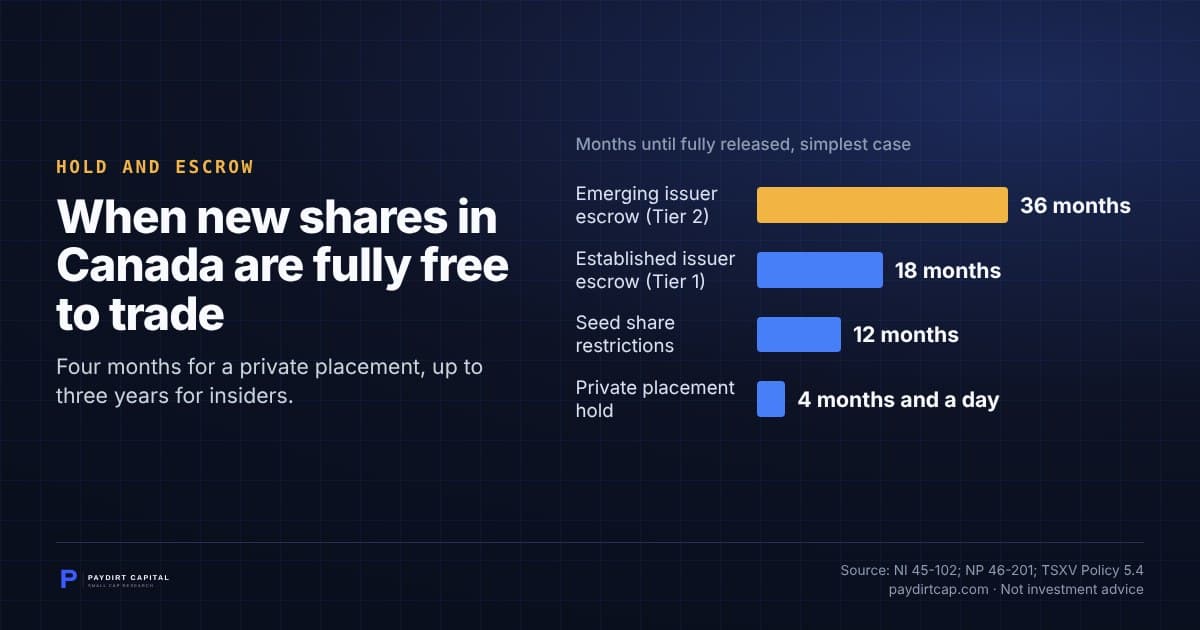
Code 10 purchases get the most attention because the insider chose to spend their own money at the market price. Code 16 is different. A private placement is priced by negotiation, often comes with a warrant, and under Canadian resale rules the shares usually carry a hold period of four months and a day. An insider joining a placement is still a cash commitment, but the terms differ from a market buy.
Code 50 is a grant. The insider did not decide to buy anything. Code 97 and code 99 lines need the remarks field before you draw any conclusion.
How to read a single filing
Each transaction line shows the security, the transaction date, the code, the number of securities acquired or disposed of, the unit price and the balance held after the trade. The transaction date is the trade date, not the settlement date.
Holdings are split by type of ownership: direct, indirect (held through a named registered holder such as a holding company or a registered plan) and control or direction. One person can have several lines for the same stock. Add them up before judging the size of a position.
Compare the filing date with the transaction date. A gap longer than five days means the report was late. A pattern of late filings is itself information about how a company handles compliance.
By the numbers: sizing a trade (hypothetical)
A worked example with invented figures shows why the balance column matters more than the headline.
- Director A holds 400,000 shares and files a code 10 purchase of 50,000 shares at $0.40. That is $20,000 of cash and a 12.5% increase in her position.
- Director B exercises 200,000 options at $0.10 (code 51) and on the same day sells 200,000 shares at $0.45 (code 10). His share balance ends where it started. He paid $20,000 to exercise and received $90,000 from the sale, a gross difference of $70,000 before tax and commissions.
- Director C files a code 50 grant of 300,000 options. No cash moved.
A screen that counts "insider buys" would log A and B as one buy and one sell. The filings themselves show one cash purchase, one cashless monetization of compensation, and one grant.
Common misreads
- Treating every sale as a signal. Insiders sell for taxes, diversification, or to fund an option exercise. A sale paired with a code 51 exercise is a routine pattern.
- Treating every acquisition as a buy. Grants, warrant exercises and share-for-services lines all raise holdings without an open-market decision.
- Ignoring the denominator. A 10,000 share purchase means little to someone who already holds 5 million.
- Reading silence as confidence. No filing can simply mean no trade, or a trading blackout around results.
Insider activity also shows up in year-end selling around tax-loss season and in flow-through financings, where directors often subscribe for the tax deduction.
What to watch
- SEDI filings in the five days after a financing closes, which show which insiders subscribed and how much
- Issuer grant reports, and the March 31 deadline for deferred compensation filings
- Filing dates that trail transaction dates by more than five days
- The outstanding share data section of the next MD&A, to reconcile insider totals with options and warrants
Sources
- Canadian Securities Administrators: Insider Reporting (SEDI)
- Ontario Securities Commission: Insider reporting
- OSC: Unofficial consolidation of NI 55-104 and Companion Policy 55-104CP
- SEDI Help: Nature of transaction codes
- SEDI: Late filing fact sheet
- BC Laws: National Instrument 55-102 System for Electronic Disclosure by Insiders
- Venture Law Corporation: Canadian resale rules
Frequently asked questions
How long do Canadian insiders have to report a trade on SEDI?
Under National Instrument 55-104, a reporting insider generally must file within five calendar days of any change in holdings, and within 10 days of first becoming a reporting insider. Stock-based compensation can be deferred to March 31 of the next year if the issuer files an issuer grant report. Late filers should still file and may face a late filing fee.
What does transaction code 10 mean on SEDI?
Code 10 on SEDI means an acquisition or disposition in the public market, so the insider bought or sold on the exchange at market prices. It gets the most attention because it reflects a cash decision. Code 16 is a prospectus-exempt deal such as a private placement, and code 50 is a grant of options with no cash involved.
Is an insider selling shares a bad sign?
Not by itself. Insiders sell for taxes, diversification or to fund option exercises. A common pattern is a code 51 option exercise paired with a code 10 sale on the same day, which leaves the share balance unchanged. Read the full filing, the balance after the trade, and all of the insider's accounts before drawing conclusions.
Related reading
Disclaimer
This content is published by Paydirt Capital, a brand of Apollo Shareholder Relations, for informational purposes only. It is not investment advice, a recommendation, or an offer or solicitation to buy or sell any security. Nothing here should be relied on for investment decisions. Readers should conduct their own due diligence and consult a registered investment advisor before making any investment.
Apollo Shareholder Relations provides paid investor relations, marketing, and communications services to publicly traded companies and may be compensated in cash or securities by companies in the sectors discussed. Where a company mentioned in this content is or becomes a client, Apollo may hold a financial interest in that company and its securities. This content is not independent research.
All facts and figures are drawn from public sources believed to be reliable, but accuracy is not guaranteed. Any forward-looking statements reflect current expectations only and actual outcomes may differ materially. Paydirt Capital and Apollo Shareholder Relations accept no liability for any loss arising from the use of this content.
The Weekly Dig
Find more good dirt in your inbox. The latest stories and ideas, free to subscribe.
Free to subscribe. Unsubscribe anytime. Sponsored content is disclosed.