How Gold Hedging Works for Miners: Forwards, Collars and Why Most Don't
Forward sales, puts and collars explained with a worked example, plus the data on why the global gold hedge book has shrunk to a fraction of its 2001 peak.
Key takeaways
- A forward sale fixes the price on future ounces at no upfront cost, but the miner gives up any gain if gold rises above it.
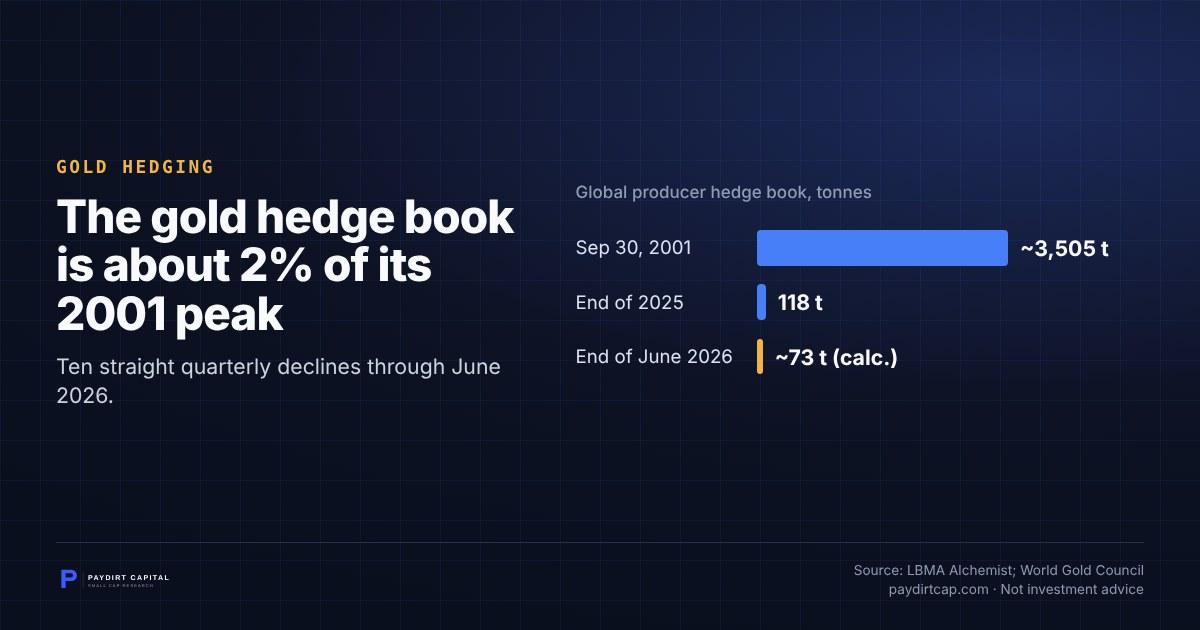
- The WGC reported the producer hedge book fell for ten straight quarters through Q2 2026, from 118 tonnes at end-2025.
- Most producers stay unhedged because investors want gold price exposure, while lenders to new mines often still require hedges.
A gold miner that hedges agrees today on the price it will get for ounces it has not yet produced. Most large producers choose not to. The World Gold Council's data shows the global producer hedge book shrinking for ten straight quarters through June 2026, to a sliver of where it stood at its 2001 peak.
What a hedge actually is
A miner's revenue is ounces sold times the gold price. It controls the first number and has no control over the second. A hedge fixes, or puts a floor under, the price on some of those future ounces. The two tools that matter are forward sales and options.
Forward sales. The miner commits to deliver a set number of ounces on a future date at a price agreed now. There is no upfront cost. If gold falls, the miner is protected. If gold rises above the contract price, the miner still delivers at the lower price and gives up the difference. The LBMA's Alchemist journal describes it plainly: the miner absorbs the loss if market prices rise above the contracted rate.
Put options. A put gives the miner the right to sell at a set strike price. It works like insurance: it pays off only if gold falls below the strike, and the miner pays a premium upfront for it.
Collars. A collar pairs a bought put with a sold call. The put sets a floor. The sold call sets a ceiling, and the premium received for it pays for the put, which is why collars are often called zero-cost. Between the two strikes, the miner receives the market price.
Why a forward price sits above spot
A gold forward price is not a forecast. The World Gold Council's guidance paper on gold deposit rates defines it as the spot price plus the cost of financing and storage, minus the metal's convenience yield. In practice the gap between spot and forward, called contango, is set by the difference between dollar interest rates and the rate for borrowing gold, known as the lease rate.
That link explains much of the history. A 2003 Alchemist analysis of the hedge book noted that the one-month dollar contango fell from about five per cent at the start of 2001 to about one per cent by 2003, as interest rates dropped. When contango is wide, a forward sale locks in a meaningful premium to spot. When it is thin, the premium mostly disappears and the case for selling forward weakens.
By the numbers: the hedge book then and now
| Date | Producer hedge book | Source |
|---|---|---|
| September 30, 2001 | 112.7 million ounces (about 3,505 tonnes) | LBMA Alchemist Issue 31 |
| March 31, 2003 | 77.3 million ounces, delta-adjusted | LBMA Alchemist Issue 31 |
| December 2009 | Barrick closes out its last 3.0 million ounces of gold hedges | Barrick |
| End of Q4 2025 | 118 tonnes (about 3.8 million ounces) | World Gold Council |
| Q1 2026 | Down 22 tonnes | World Gold Council |
| Q2 2026 | Down 23 tonnes, tenth straight quarterly decline | World Gold Council |
The arithmetic: 118 tonnes less the 45 tonnes removed in the first half of 2026 leaves roughly 73 tonnes at the end of June 2026, by our calculation from the WGC's figures. Global mine production in the first half of 2026 was 1,867 tonnes, according to the WGC. The entire industry hedge book at mid-year was about 4% of six months of mine output, and about 2% of its 2001 peak.
A worked hedge, with hypothetical numbers
Take a miner with gold at a hypothetical US$3,000 an ounce, dollar rates of 4% and a gold lease rate of 1%. The one-year contango is about 3%, so a one-year forward sale prices near US$3,090. The miner could instead purchase a US$2,700 put and write a US$3,500 call. Here is what each ounce earns a year later under three outcomes.
| Gold price at delivery | Unhedged | Forward at $3,090 | Collar $2,700 to $3,500 |
|---|---|---|---|
| $2,400 | $2,400 | $3,090 | $2,700 |
| $3,000 | $3,000 | $3,090 | $3,000 |
| $3,800 | $3,800 | $3,090 | $3,500 |
The forward wins only when gold falls. The collar trades some upside for a floor. Unhedged ounces carry the full swing in both directions. None of these outcomes is known when the hedge is placed, which is the whole point.
Why most producers stay unhedged
Three forces keep hedge books small.
- Shareholders want the exposure. Investors often own gold miners as a leveraged position on the gold price. The LBMA's Alchemist notes that investors typically resist hedging. The WGC said in its Q1 2026 supply commentary that hedging activity is likely to stay limited given investor preference for full exposure to elevated spot prices.
- History left scars. The same Alchemist piece lists Ashanti, Pasminco and Sons of Gwalia among hedging failures, most of which used structures that were not true hedges. When Barrick finished eliminating its hedges in December 2009, its chief executive said its production and reserves were "now completely unhedged."
- Old hedges hurt in a rising market. The WGC reported in 2026 that legacy contracts priced far below spot had hit margins at some operations, prompting companies to restructure out-of-the-money positions, including converting forward sales to put options.
The gold price is only half of a miner's margin. The other half is cost per ounce, covered in our explainer on all-in sustaining costs.
When hedging still shows up
The main exception is debt. The Alchemist analysis calls debt financing the most critical driver of hedging: lenders to a new mine often require a hedge so the loan can be repaid if prices fall. The WGC's 2026 reports noted fresh hedges tied to debt financing even as the overall book shrank. A developer building its first mine with project debt is a different animal from a large producer with a strong balance sheet.
For investors, a company's hedge position is disclosed in its financial statements and MD&A: the ounces committed, the delivery schedule and the contract prices. Those three numbers tell you how much of the next few years' revenue is already fixed.
What to watch
- The World Gold Council's quarterly Gold Demand Trends supply section, which reports the change in the producer hedge book each quarter.
- Derivative and hedge disclosures in producers' quarterly MD&A and financial statement notes.
- Project financing announcements that include hedging requirements set by lenders.
- Dollar interest rates and gold lease rates, which set the contango a forward sale can capture.
Sources
- World Gold Council, Gold Demand Trends Q2 2026: Supply
- World Gold Council, Gold Demand Trends Q1 2026: Supply
- World Gold Council, Gold deposit rates: a guidance paper
- LBMA Alchemist Issue 31, The Gold Hedge Indicator
- LBMA Alchemist Issue 66, The Challenges of Hedging
- Barrick, Barrick Completes Elimination of All Gold Hedges (December 1, 2009)
Frequently asked questions
How does a gold forward sale work for a mining company?
The miner commits to deliver a set number of ounces on a future date at a price agreed now, with no upfront cost. If gold falls, the miner is protected. If gold rises above the contract price, the miner still delivers at the lower price and gives up the difference, which is the main reason shareholders dislike them.
What is a zero-cost collar in gold hedging?
A collar pairs a bought put option with a sold call option. The put sets a price floor and the call sets a ceiling. The premium received for selling the call pays for the put, which is why it is called zero-cost. Between the two strike prices, the miner simply receives the market price for its gold.
Why don't most gold miners hedge their production?
Investors typically own gold miners for exposure to the gold price and resist hedging. Past hedging failures such as Ashanti left a lasting mark, and legacy contracts priced below spot have hurt margins. The World Gold Council said in 2026 that hedging is likely to stay limited given investor preference for full spot exposure.
Related reading
Disclaimer
This content is published by Paydirt Capital, a brand of Apollo Shareholder Relations, for informational purposes only. It is not investment advice, a recommendation, or an offer or solicitation to buy or sell any security. Nothing here should be relied on for investment decisions. Readers should conduct their own due diligence and consult a registered investment advisor before making any investment.
Apollo Shareholder Relations provides paid investor relations, marketing, and communications services to publicly traded companies and may be compensated in cash or securities by companies in the sectors discussed. Where a company mentioned in this content is or becomes a client, Apollo may hold a financial interest in that company and its securities. This content is not independent research.
All facts and figures are drawn from public sources believed to be reliable, but accuracy is not guaranteed. Any forward-looking statements reflect current expectations only and actual outcomes may differ materially. Paydirt Capital and Apollo Shareholder Relations accept no liability for any loss arising from the use of this content.
The Weekly Dig
Find more good dirt in your inbox. The latest stories and ideas, free to subscribe.
Free to subscribe. Unsubscribe anytime. Sponsored content is disclosed.