How to Read a Junior Mining Company's MD&A: The Parts That Matter
An explorer's MD&A holds its cash position, spending by property, use of proceeds and full share count. Here is where to look and what the rules require.
Key takeaways
- Liquidity is the first section to read in an explorer's MD&A because the company spends cash and does not earn it.
- Venture issuers without significant revenue must break down exploration spending property by property, alongside general and administration costs.
- The outstanding share data section is dated as late as practicable and gives the most current count of shares, options and warrants.
The MD&A is management's written explanation of the financial statements. For an exploration company with no revenue, most of the useful information sits in five places: liquidity, exploration spending by property, use of proceeds, related party transactions and outstanding share data. Canadian rules require each of them, which makes them easy to find once you know where to look.
What an MD&A is and when it arrives
Form 51-102F1 defines MD&A as "a narrative explanation, through the eyes of management, of how your company performed during the period covered by the financial statements, and of your company's financial condition and future prospects." The form tells companies to discuss liquidity and capital resources openly, "reporting bad news as well as good news," and to explain the reasons for changes instead of just restating them.
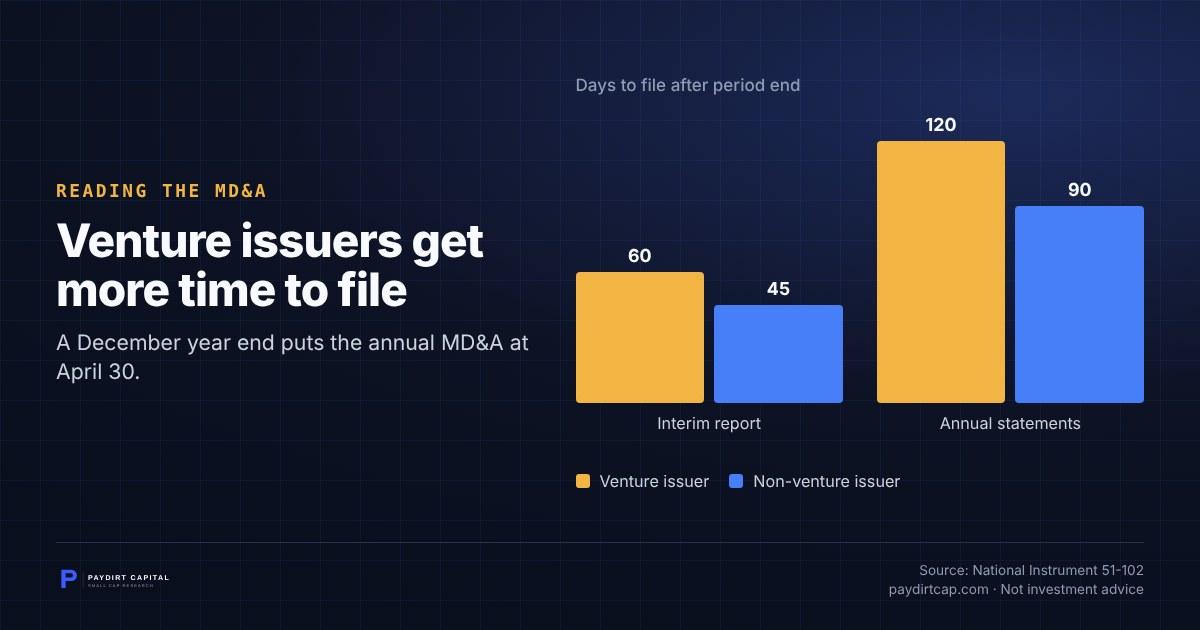
MD&A is filed with the financial statements. National Instrument 51-102 sets the deadlines, and venture issuers get more time:
| Filing | Venture issuer | Non-venture issuer |
|---|---|---|
| Annual audited statements | 120 days after year end | 90 days after year end |
| Interim financial report | 60 days after quarter end | 45 days after quarter end |
For a venture issuer with a December 31 year end, that puts the annual filing at April 30 and a September 30 quarter in late November. Venture issuers can also meet the interim requirement with a shorter document titled Quarterly Highlights, which must still cover operations, liquidity, capital resources, changes in use of proceeds and significant related party transactions.
Liquidity: start here
An explorer spends money and does not earn it. The first question is how long the cash lasts. Section 1.6 of the form requires an analysis of the company's ability to generate enough cash to fund its plans, its working capital requirements, and, if it has or expects a working capital deficiency, how it plans to meet obligations and fix the deficiency.
Look for three things in this section:
- Working capital at period end, and any change since
- Commitments, such as option payments on properties, work commitments and unspent flow-through funds that must go into eligible exploration
- How management says it will fund the next 12 months
Then read the auditor's report attached to the annual statements. When there is a material uncertainty about the company's ability to continue as a going concern, Canadian Auditing Standard 570 requires a section titled "Material Uncertainty Related to Going Concern." CPA Ontario notes the assessment covers at least twelve months from the date the statements are approved. For explorers this paragraph is common. It confirms the company will need new money to continue its plans.
Exploration spending, property by property
Section 5.3 of NI 51-102 applies to venture issuers without significant revenue in either of their last two financial years. They must break down the material components of:
- Exploration and evaluation assets or expenditures
- Expensed research and development costs
- Intangible assets arising from development
- General and administration expenses
- Any other material costs
If the business is mainly mining exploration and development, the exploration analysis must be presented property by property. Annual MD&A covers the last two financial years. The breakdown can sit in the financial statement notes instead, in which case the MD&A may point there.
This table answers a simple question: how much money went into the ground, and on which project? Drilling, assays and geology show up here. So does claim maintenance. Compare the total with general and administration costs over the same period.
Use of proceeds: promises versus spending
Section 1.4(i) requires a comparison, in tabular form, of what the company previously said it would do with money raised in a financing against what it actually did, with an explanation of variances and their effect on milestones. Section 1.4(d) asks companies with projects not yet producing revenue to describe each project, the plan, the status against that plan, and how spending relates to the expected timing and cost of the next stage.
Read the offering document or news release for the last financing next to this table. A drill program that shrank, or money redirected to working capital, will show up here first.
Related parties and outstanding share data
Section 1.9 covers transactions between related parties. At junior issuers this often means management fees or consulting fees paid to companies controlled by officers, or shared office costs. Size those payments against total general and administration expense.
Section 5.4 of NI 51-102 requires outstanding share data: every class of shares outstanding, every security convertible or exercisable into shares, and the number of shares issuable. It must be prepared as of the latest practicable date, which is often weeks after the period end. That makes it the most current count of shares, options and warrants in the document, including any financing that closed after the quarter.
The math: a runway check (hypothetical)
An invented company reports $3.0 million of working capital at quarter end. Its MD&A shows quarterly general and administration spending of $400,000 and a planned $2.0 million drill program over the next two quarters.
- Twelve months of overhead: 4 x $400,000 = $1.6 million
- Plus the drill program: $1.6 million + $2.0 million = $3.6 million
- Against working capital of $3.0 million: a $600,000 gap
On those numbers the company would need new financing inside a year to complete its stated plan. A going concern note would be consistent with that. The same property table also shows whether last year's spending leaned toward the ground or toward overhead. If exploration was $1.5 million and general and administration was $1.2 million, overhead took 44% of the total.
For how to read the results that spending produces, see our guides to drill results and NI 43-101 technical reports.
What to watch
- Filing dates against the 60 and 120 day venture deadlines
- The "as of" date on the outstanding share data section
- Whether the auditor's report includes a going concern section
- Variances in the use of proceeds table
- Subsequent events notes, which list financings, grants and property deals after period end
Sources
- OSC: Unofficial consolidation of Form 51-102F1 Management's Discussion and Analysis
- OSC: Unofficial consolidation of National Instrument 51-102 Continuous Disclosure Obligations
- CPA Ontario: The revised CAS 570, Going Concern, FAQ
Frequently asked questions
When do junior mining companies file their MD&A?
MD&A is filed with the financial statements. Under National Instrument 51-102, a venture issuer must file annual audited statements within 120 days of year end and interim reports within 60 days of quarter end. Non-venture issuers have 90 and 45 days. A venture issuer with a December 31 year end files its annual report by April 30.
What does a going concern note mean for an exploration company?
When there is a material uncertainty about a company's ability to continue, Canadian Auditing Standard 570 requires a section in the auditor's report titled Material Uncertainty Related to Going Concern. The assessment covers at least twelve months from the approval date. For explorers without revenue it is common, and it signals the company will need new financing to continue its plans.
Where do I find the fully diluted share count in an MD&A?
Look for the outstanding share data section required by section 5.4 of National Instrument 51-102. It lists each class of shares outstanding, every security convertible or exercisable into shares, and the number of shares issuable. It is prepared as of the latest practicable date, often weeks after period end, so it can include financings that closed after the quarter.
Related reading
Disclaimer
This content is published by Paydirt Capital, a brand of Apollo Shareholder Relations, for informational purposes only. It is not investment advice, a recommendation, or an offer or solicitation to buy or sell any security. Nothing here should be relied on for investment decisions. Readers should conduct their own due diligence and consult a registered investment advisor before making any investment.
Apollo Shareholder Relations provides paid investor relations, marketing, and communications services to publicly traded companies and may be compensated in cash or securities by companies in the sectors discussed. Where a company mentioned in this content is or becomes a client, Apollo may hold a financial interest in that company and its securities. This content is not independent research.
All facts and figures are drawn from public sources believed to be reliable, but accuracy is not guaranteed. Any forward-looking statements reflect current expectations only and actual outcomes may differ materially. Paydirt Capital and Apollo Shareholder Relations accept no liability for any loss arising from the use of this content.
The Weekly Dig
Find more good dirt in your inbox. The latest stories and ideas, free to subscribe.
Free to subscribe. Unsubscribe anytime. Sponsored content is disclosed.